Transforming medical equipment procurement globally

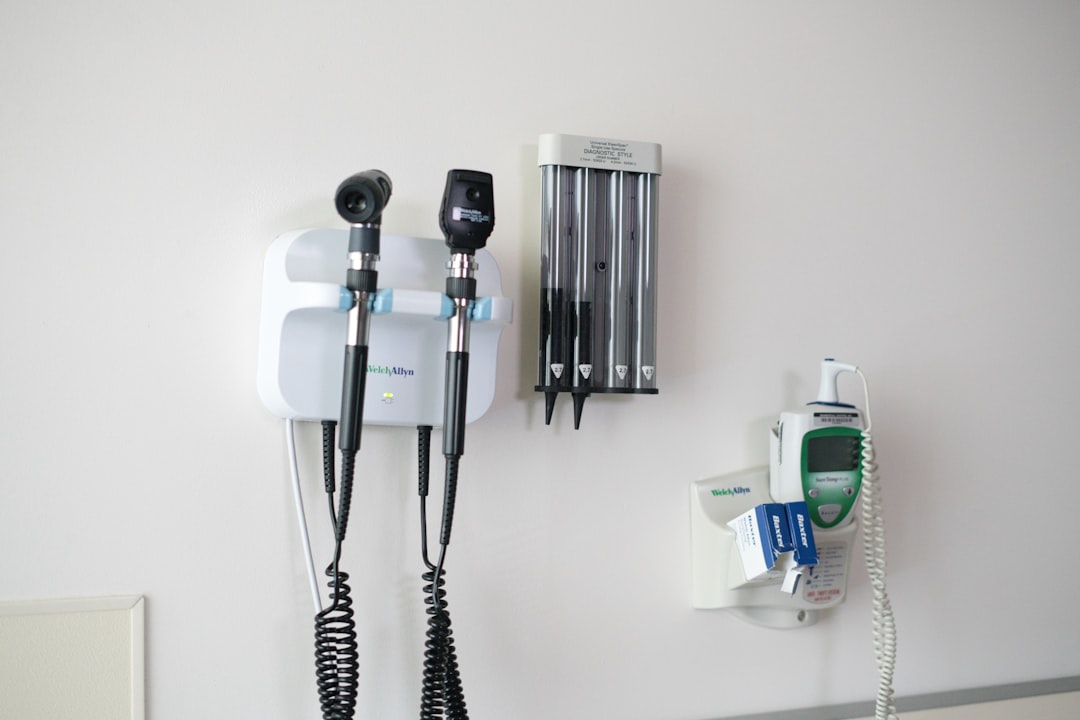
Why Medical Equipment Compliance Matters More Than Ever

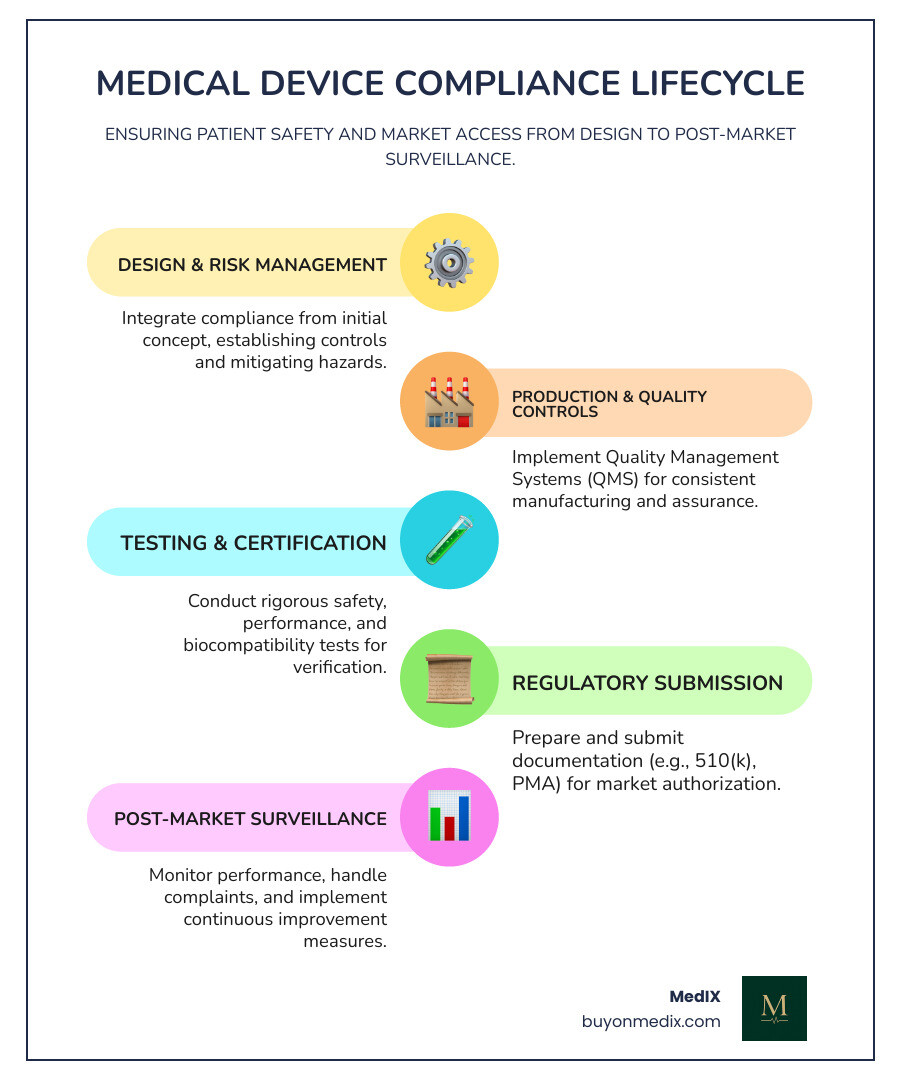
Medical equipment compliance is the foundation of patient safety and market access in healthcare. It means manufacturers must meet all regulations and standards throughout a device's lifecycle, from design to post-market surveillance.
Key aspects of medical equipment compliance include:
- Patient Safety - Ensuring devices are safe and effective when used as intended
- Regulatory Approval - Meeting requirements to legally market devices (FDA, EU MDR, etc.)
- Quality Management - Implementing systems like ISO 13485 to maintain consistent quality
- Risk Management - Identifying and mitigating potential hazards throughout the device lifecycle
- Testing & Certification - Verifying electrical safety, biocompatibility, and performance standards
- Market Access - Gaining approval to sell in different countries and regions
The performance of medical devices can be a matter of life and death. Without proper medical device compliance, companies risk harming patients, facing litigation, and suffering severe reputational damage.
For procurement managers, understanding compliance is critical. You must ensure every device you source meets rigorous safety and quality standards. A single non-compliant device can trigger costly recalls, legal penalties, and compromise patient safety.
The regulatory landscape is evolving. The FDA recently issued the Quality Management System Regulation (QMSR) Final Rule, which harmonizes US requirements with the international standard ISO 13485:2016. Effective February 2, 2026, it gives manufacturers a two-year transition period.
Buyers must work with suppliers who understand these changes and can prove compliance through proper documentation. The challenge is finding verified suppliers who can prove their products meet all applicable standards across different markets.
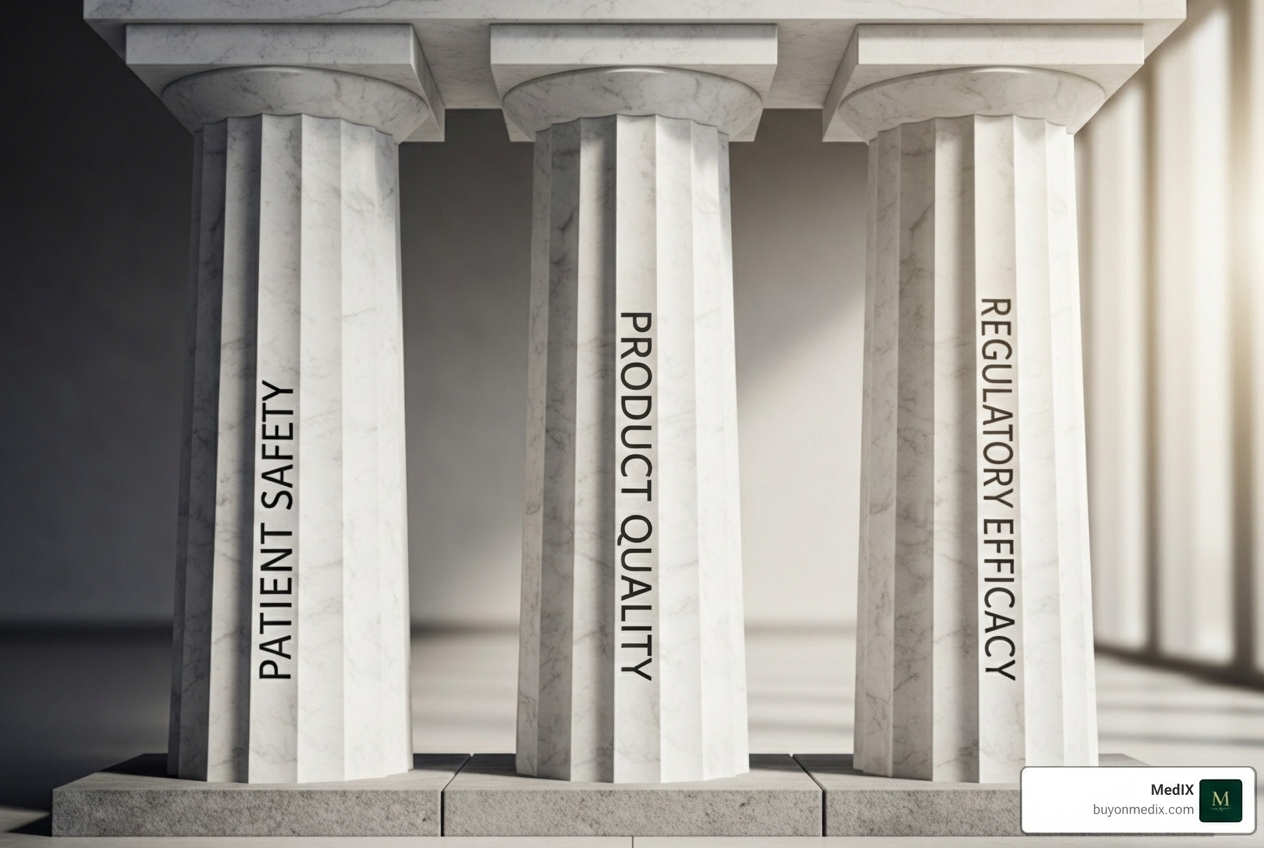
Medical device compliance serves three fundamental purposes:
- Protecting patients by ensuring devices perform safely and as intended
- Enabling market access by meeting regulatory requirements in target countries
- Building trust through transparent quality management and documentation
The stakes are high. The costs of non-compliance—fines, recalls, and lost market access—far exceed the investment in a proper compliance program.
The Foundation: What is Medical Device Compliance and Why is it Crucial?
At its core, medical device compliance is the continuous adherence to all relevant regulations, laws, and standards governing medical devices. This commitment spans the entire product lifecycle, from design to post-market surveillance, ensuring every device is safe, effective, and performs as intended.
For manufacturers, compliance is a strategic necessity for economic viability. It builds an unshakeable reputation, fosters trust, and fulfills legal obligations. Without it, market access is impossible, and the business model fails.
For a deeper dive into specific European compliance markers, check out our guide on More info about CE Marked Medical Devices.
The Primary Goals of Compliance
The core objectives of robust medical equipment compliance are designed to safeguard public health and ensure a responsible industry:
- Patient Safety: The paramount goal. Compliance ensures devices are designed, manufactured, and used to minimize risks and maximize beneficial outcomes.
- Quality Assurance: Mandates rigorous quality management systems to ensure consistent product quality, reliability, and effectiveness.
- Performance Verification: Requires robust testing and validation to verify that a device achieves its stated performance claims.
- Regulatory Approval: Meeting requirements from bodies like the FDA or under the EU MDR is essential to legally sell a device.
- Gaining Access to Global Markets: Adherence to internationally recognized standards often streamlines access to multiple markets.
- Maintaining Brand Reputation: A strong compliance record signals a manufacturer's commitment to quality and safety, enhancing its reputation.
The Severe Consequences of Non-Compliance
Ignoring medical device compliance has devastating repercussions for manufacturers, far outweighing any perceived cost savings:
- Legal Penalties and Fines: Regulatory bodies can levy substantial fines, potentially crippling a company financially.
- Product Recalls: Unsafe or non-compliant devices can be subject to mandatory recalls, which are expensive and damage public trust.
- Reputational Damage: News of non-compliance or patient harm spreads rapidly. Rebuilding a tarnished reputation can take years, if it's possible.
- Loss of Market Access: Non-compliant devices will be blocked from entering or removed from markets, shutting down revenue streams.
- Criminal Charges: In severe cases where non-compliance leads to serious injury or death, executives and employees can face criminal prosecution.
The cost of compliance is an investment in patient safety and business longevity. The cost of non-compliance is often the end of the line. For more on regulated medical equipment, see our insights on More info about CE Marked Devices.
Navigating the Global Landscape of Medical Equipment Compliance
The global medical equipment compliance landscape is complex, with regulations varying by country. The common thread is a commitment to patient safety and product efficacy. Manufacturers operating globally must steer this web by understanding the specific requirements of each target market.
Major players like the FDA in the United States and the EU MDR in Europe set benchmarks that influence regulations worldwide. Harmonization efforts, such as the FDA's QMSR Final Rule aligning with ISO 13485, aim to streamline this process for manufacturers.
For companies looking to distribute their products internationally, a strong understanding of these global frameworks is non-negotiable. Explore our insights on More info about Global Medical Device Distributors.
Key Regulatory Bodies and Standards
Manufacturers must adhere to specific regulations and standards. Here are the key players:
- US Food and Drug Administration (FDA): The primary U.S. regulatory authority, ensuring medical devices are safe and effective.
- 21 CFR Part 820 (Quality System Regulation - QSR): Traditionally governed quality systems in the US, covering design, validation, and manufacturing. It is now undergoing significant changes.
- 21 CFR Part 11: Governs the FDA's acceptance of electronic records and signatures.
- International Organization for Standardization (ISO): A global body that develops and publishes international standards.
- ISO 13485:2016: The global standard for medical device quality management systems (QMS).
- ISO 14971:2019: The global standard for applying risk management to medical devices.
- ISO 14155:2020: The global standard for Good Clinical Practice (GCP) in clinical investigations of medical devices.
- International Electrotechnical Commission (IEC): A worldwide organization for electrotechnical standardization.
- IEC 60601-1: A foundational standard for the safety and performance of medical electrical equipment.
- EU Medical Device Regulation (EU MDR) and EU In Vitro Diagnostic Regulation (EU IVDR): The EU's regulations for medical and in vitro diagnostic devices, featuring stricter controls and transparency than previous directives.
The Evolution of Regulations: The QMSR Final Rule
A significant recent development is the FDA's Quality Management System Regulation (QMSR) Final Rule, which amends the Quality System (QS) regulation (21 CFR Part 820).
The core of this amendment is harmonization with ISO 13485:2016. The FDA is incorporating this international QMS standard into its framework, a major step toward aligning U.S. requirements with global best practices and simplifying compliance.
The FDA's The FDA's final rule on QMSR was issued to modernize its regulatory framework. The rule is effective February 2, 2026, providing a two-year transition period for manufacturers to update their quality systems.
This change requires manufacturers to integrate the principles of ISO 13485:2016, making them a legal requirement for selling devices in the U.S. It represents a proactive effort by the FDA to promote quality design and manufacturing practices.
Core Principles: Quality, Risk, and Performance
At the heart of medical equipment compliance are core principles: unwavering quality, meticulous risk management, and verified performance. These are the bedrock of safe and effective medical devices. Manufacturers are accountable for ensuring their devices perform as intended without compromising patient safety, using robust design and manufacturing controls.
The Essential Principles of Safety and Effectiveness for Medical Devices highlight that devices must be designed so that benefits outweigh risks, and any risks are compatible with a high level of health and safety.
Core Elements of an Effective QMS for Medical Equipment Compliance
An effective Quality Management System (QMS) is the backbone of a medical device company, documenting processes to ensure products are consistently safe and effective. Key elements, guided by ISO 13485 and the FDA's QSR, include:
- Design Controls: Rigorous procedures for design and development, ensuring inputs are met and outputs are verified and validated to prevent costly errors.
- Document Control: Managing critical documents and records to ensure they are approved, distributed, and retained appropriately, which is crucial for audits.
- Production and Process Controls: Procedures to ensure manufacturing processes are controlled and validated to produce devices that meet specifications, following good manufacturing practices (GMP).
- Corrective and Preventive Actions (CAPA): A systematic process to investigate, correct, and prevent nonconformances, driving continuous improvement.
- Supplier Management: Ensuring all suppliers meet quality requirements, as their components impact the final device's quality and safety.
- Complaint Handling: A system for receiving, evaluating, and investigating complaints and reporting adverse events to authorities.
The Central Role of Risk Management (ISO 14971)
Risk management is a philosophy underpinning the entire medical device lifecycle. The global standard, ISO 14971:2019, provides a systematic approach to identifying, evaluating, controlling, and monitoring risks.
The risk management lifecycle is continuous:
- Hazard Identification: Proactively identifying potential sources of harm.
- Risk Analysis and Evaluation: Estimating the probability and severity of harm to evaluate if the risk is acceptable.
- Risk Control: Implementing measures to reduce unacceptable risks.
- Verification of Risk Controls: Ensuring that the implemented controls are effective.
- Post-market Risk Monitoring: Continuously monitoring the device on the market to identify new risks.
Manufacturers must demonstrate they have identified hazards, calculated risks, and implemented control measures. The goal is to ensure the device's benefits outweigh any acceptable residual risks.
The Path to Market: Classification, Testing, and Certification
Bringing a medical device to market is a rigorous journey influenced by its classification, testing, and certification. Understanding these steps is key for manufacturers to streamline the process and ensure timely market entry. A comprehensive testing strategy planned early in development simplifies compliance. For more on how logistics plays a role, refer to our More info about Medical Equipment Logistics Complete Guide.
How Device Classification Impacts Compliance Requirements
Medical devices are classified based on their potential risk, which dictates the level of regulatory control and compliance requirements.
| Feature | Class I (Low Risk) | Class II (Moderate Risk) | Class III (High Risk) |
|---|---|---|---|
| Examples | Bandages, tongue depressors, basic surgical tools | Infusion pumps, powered wheelchairs, diagnostic ultrasound | Pacemakers, heart valves, implantable defibrillators |
| Regulatory Control | General Controls | General Controls + Special Controls | General Controls + Premarket Approval |
| Premarket Submission | Many are exempt from 510(k) | Typically requires Premarket Notification 510(k) | Requires Premarket Approval (PMA) |
| Clinical Data | Generally not required | Sometimes required (for 510(k)) | Almost always required (extensive for PMA) |
| QMS Requirements | Generally less stringent (but still apply) | Full QMS (e.g., 21 CFR Part 820 / ISO 13485) | Full QMS (e.g., 21 CFR Part 820 / ISO 13485) |
| Time to Market | Fastest | Moderate | Longest, most complex |
- Class I (Low Risk): These devices pose the least harm. Many are exempt from Premarket Notification 510(k) but are still subject to general controls like GMP, proper labeling, and adverse event reporting.
- Class II (Moderate Risk): These devices usually require a Premarket Notification 510(k) submission to demonstrate the device is "substantially equivalent" to a legally marketed predicate device.
- Class III (High Risk): These devices support or sustain life or present a potential unreasonable risk. They require Premarket Approval (PMA), the most stringent application, which needs extensive scientific and clinical data to prove safety and effectiveness.
Understanding your device's classification is the first step in your compliance journey. For more details, refer to our More info about Classification of Medical Devices PDF.
Critical Testing and Evaluation Services
Once classified, a device undergoes numerous tests to meet safety and performance standards, which are crucial for verifying device integrity and protecting patients.
- Electrical Safety (IEC 60601 series): For electrically powered devices, the IEC 60601-1 standard specifies requirements for basic safety and performance. This includes testing for protection against electric shock, mechanical hazards, and radiation.
- Electromagnetic Compatibility (EMC): Devices must function safely in their electromagnetic environment without causing or being susceptible to interference. IEC 60601-1-2 is the key international standard. This testing ensures a device won't malfunction due to common interferences.
- Biocompatibility (ISO 10993 series): For devices in contact with the body, testing guided by the ISO 10993 series evaluates the biological response and potential adverse effects like cytotoxicity, sensitization, and irritation.
- Sterilization Validation: For devices that must be sterile, validation ensures the chosen sterilization method (e.g., ethylene oxide, gamma radiation) consistently achieves the required sterility assurance level (SAL), confirmed through microbiological and packaging tests.
- Software and Cybersecurity: For connected devices and Software as a Medical Device (SaMD), cybersecurity is critical. Devices must be protected against unauthorized access and malicious attacks. This requires vulnerability testing, secure coding, and defining interoperability requirements. Dive deeper into this topic with our insights on More info about Cybersecurity Medical Devices.
Unique Challenges and Strategic Solutions
The medical equipment compliance journey has unique challenges, from specific device types to complex global market entry. These can be met with strategic solutions, expert advice, and advanced tools. For navigating distribution intricacies, our guide on More info about Medical Device Logistics can be invaluable.
Special Considerations for DME, Connected Devices, and Software
Certain device categories have distinct compliance problems:
- Durable Medical Equipment (DME): Devices prescribed for home use (e.g., wheelchairs, oxygen concentrators) face unique standards, especially when dealing with programs like Medicare. The OIG outlines 7 fundamental elements for an effective compliance program for DME companies:
- Implementing written policies, procedures, and standards of conduct.
- Designating a compliance officer and compliance committee.
- Conducting effective training and education.
- Developing effective lines of communication.
- Enforcing standards through well-publicized disciplinary guidelines.
- Conducting internal monitoring and auditing.
- Responding promptly to detected offenses and developing corrective action.These elements address billing, anti-kickback statutes, and patient referral practices.
- Connected Devices and Internet of Things (IoT): Connected devices (e.g., smart wearables, remote monitors) present challenges in data security, interoperability, and privacy. They must be robust against cyber threats and integrate seamlessly into healthcare IT systems.
- Software as a Medical Device (SaMD): Software that functions as a medical device (e.g., diagnostic apps) is a growing field. SaMD compliance involves software validation, cybersecurity, data integrity (per 21 CFR Part 11), and performance verification in a digital context.
How to Streamline the Testing and Certification Process
Manufacturers can adopt several strategies to streamline the complex testing and certification process:
- Early-Stage Planning: Integrate compliance considerations from the start of the design phase. This helps avoid costly errors and speeds time to market.
- Partnering with Accredited Labs: Use accredited labs recognized by regulatory bodies. Their expertise ensures tests are conducted efficiently and meet required standards.
- Comprehensive Testing Strategies: Develop a holistic strategy covering all standards for target markets, potentially combining tests to satisfy multiple requirements.
- Leveraging Global Logistics: Efficient global logistics supports compliance by ensuring proper handling, storage, and traceability of devices across borders. For comprehensive guidance, see our article on More info about Healthcare Supply Chain Management.
Frequently Asked Questions about Medical Device Compliance
We understand that medical equipment compliance can be a complex topic, so we've compiled answers to some common questions.
What is the difference between 21 CFR Part 820 and ISO 13485?
Historically, 21 CFR Part 820 was the FDA's Quality System Regulation for the U.S., while ISO 13485 is the international QMS standard. With the new Quality Management System Regulation (QMSR) Final Rule, the FDA is harmonizing its regulation with ISO 13485:2016. By February 2, 2026, U.S. requirements will align with ISO 13485, reducing the burden of maintaining two separate systems.
How does risk classification (Class I, II, III) affect my device's path to market?
A device's risk classification is the most critical factor for its path to market. It dictates the level of regulatory scrutiny, the required premarket submission, and the amount of clinical evidence needed.
- Class I (low-risk) devices often have the simplest path, with many exempt from premarket review, though they must still adhere to general controls.
- Class II (moderate-risk) devices typically require a 510(k) submission to demonstrate "substantial equivalence" to an existing device.
- Class III (high-risk) devices face the most rigorous path, requiring a Premarket Approval (PMA) with extensive scientific and clinical data to prove safety and effectiveness.
What is the most critical first step for a startup to ensure compliance?
For a startup, the most critical first step is establishing a robust Quality Management System (QMS). It should align with target market requirements (e.g., ISO 13485, QMSR) from day one. A well-defined QMS provides the framework for all compliance activities like design controls and risk management. Adding a QMS later causes delays and increases costs. A solid quality foundation is key to a smoother compliance journey.
Conclusion
Navigating the intricate world of medical equipment compliance can seem like a monumental task, but it is an indispensable journey for every manufacturer. From ensuring patient safety and driving quality assurance to gaining crucial regulatory approvals and accessing global markets, compliance is not merely a legal obligation—it is the bedrock of trust, innovation, and economic viability in the healthcare industry.
By understanding the roles of key regulatory bodies like the FDA and the EU MDR, adhering to international standards such as ISO 13485 and ISO 14971, and implementing robust quality management and risk management systems, manufacturers can confidently bring their life-changing devices to those who need them most. The evolving regulatory landscape, exemplified by the FDA's QMSR Final Rule, underscores the need for continuous vigilance and proactive adaptation.
A proactive compliance strategy leads to market success and fosters continuous improvement, ensuring that medical devices are not only innovative but also consistently safe and effective. For those looking to source More info about Certified Medical Equipment, MedIX helps buyers connect with verified suppliers who meet rigorous compliance standards, simplifying procurement and ensuring trust.
Ready to explore a world of compliant medical equipment? Explore a global marketplace of compliant medical equipment suppliers.

Expert voices
Insights from leaders transforming medical equipment procurement


More from our blog
Discover the latest trends in medical technology and procurement
Stay ahead of medical technology
Get the latest insights, research, and market updates delivered straight to your inbox
Ready to transform your procurement
Discover how MedIX can streamline your medical equipment sourcing process