Transforming medical equipment procurement globally


Why Mini Oxygen Machine Price Matters for Healthcare Procurement

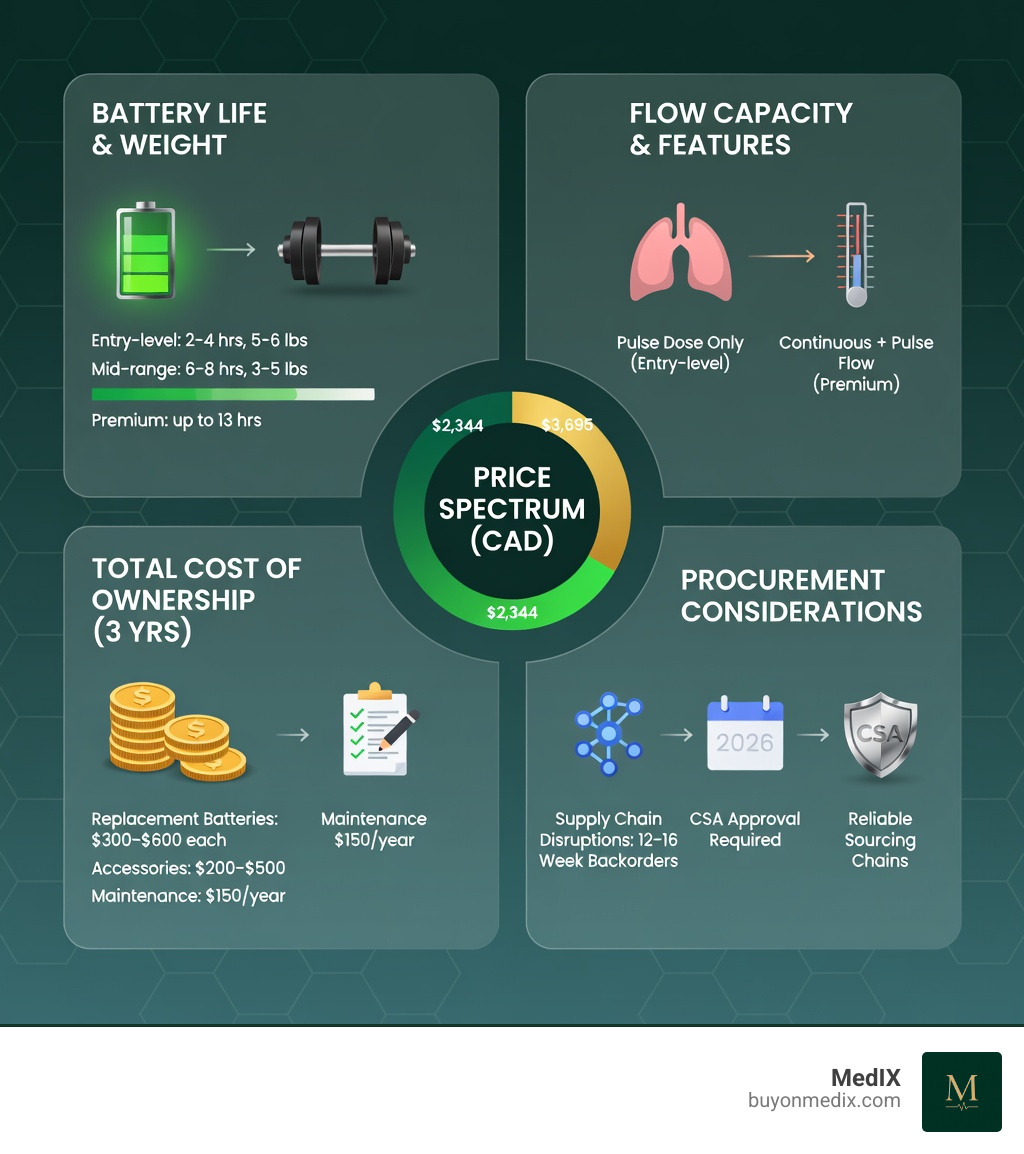
Mini oxygen machine price in Canada typically ranges from $2,344 to $3,695 CAD, depending on battery life, weight, flow capacity, and brand. Here's what you need to know:
| Price Range | Device Type | Key Features |
|---|---|---|
| $2,344 - $2,700 | Entry-level portable units | Standard battery (2-4 hours), pulse dose only, 5-6 lbs |
| $2,700 - $3,200 | Mid-range models | Extended battery (6-8 hours), FAA-approved, 3-5 lbs |
| $3,400 - $3,695 | Premium systems | Dual batteries (up to 13 hours), continuous + pulse flow, advanced features |
For healthcare procurement managers sourcing oxygen therapy equipment, understanding price variations is critical. Market research shows significant cost differences between brands like Inogen Rove 6 ($2,625 CAD), SimplyGo ($2,344-$3,150 CAD), and OxyGo NEXT ($3,495 CAD).
The challenge? Current supply chain disruptions mean many models face 12-16 week backorders. Plus, the listed price rarely reflects the total investment—you'll need to factor in prescription requirements, replacement batteries ($300-600 each), accessories, and potential customs duties for international orders.
This creates complexity for institutional buyers who need reliable supply chains, transparent pricing, and compliant equipment that meets Canadian Standards Association (CSA) approval.
The good news: understanding the price drivers—from PSA technology and oxygen purity levels to battery chemistry and flow rate capabilities—helps you make smarter procurement decisions and avoid costly mistakes.
Mini oxygen machine price helpful reading:
Understanding the Mini Oxygen Machine Price Range in Canada

When we look at the Canadian landscape for medical equipment, the mini oxygen machine price is rarely a single "sticker price." Instead, it is a spectrum influenced by regulatory standards, shipping logistics, and the specific needs of the patient. In Canada, all medical-grade oxygen concentrators must be registered and meet specific safety standards, which can sometimes result in higher base costs compared to unregulated consumer-grade "generators" found on generic marketplaces.
Typically, prices are quoted in CAD, but many high-end components are sourced globally, meaning currency fluctuations can impact the final quote. For those managing clinic budgets, a Medical Equipment Price Comparison is an essential first step to ensure you aren't overpaying for features your patients don't actually need.
| Flow Capacity | Weight Class | Estimated Price Range (CAD) |
|---|---|---|
| Pulse Dose 1-3 | Ultra-Light (<3 lbs) | $2,600 - $3,000 |
| Pulse Dose 1-5 | Standard (4-6 lbs) | $2,300 - $3,500 |
| Continuous Flow | Heavy Duty (10+ lbs) | $3,100 - $4,200 |
Average Mini Oxygen Machine Price for Pulse Dose Units
The most common "mini" machines use pulse dose technology, which delivers oxygen only when the user inhales. This conservation method allows the machines to be much smaller and the mini oxygen machine price to stay within the entry-level bracket of $2,300 to $2,700.
These units are designed for mobility. For example, the Inogen Rove 6 often starts around $2,625 CAD. While these are the most affordable medical-grade options, they do require a valid prescription. We always remind our partners that "affordable" shouldn't mean "unverified." Ensuring the device is cleared for medical use is paramount for patient safety.
Premium Mini Oxygen Machine Price for Extended Battery Models
On the higher end of the scale, you will find premium systems like the OxyGo NEXT or the SimplyGo Mini, which can push the mini oxygen machine price toward the $3,495+ range. Why the jump? These units often come with "Extended Life" batteries or premium packages that include extra accessories.
A premium package isn't just a luxury; for a patient who needs to be away from a power outlet for 8 to 13 hours, it is a necessity. These units often feature more robust warranties and higher durability ratings, making them a preferred choice for Stationary & Portable Oxygen Concentrators in long-term care settings.
Key Factors Influencing Portable Oxygen Concentrator Costs
If you have ever wondered why two machines that look identical have a $1,000 price difference, the answer usually lies under the hood. The core technology of these machines is Pressure Swing Adsorption (PSA), which uses molecular sieves to filter nitrogen out of the air. The quality of these sieves and the efficiency of the compressor are major cost drivers.
As a Durable Medical Equipment specialist would tell you, the reliability of the oxygen purity (usually 93% ± 3%) is what separates a medical device from a toy. If the purity drops as the flow rate increases, the price should reflect that lower capability.
Impact of Battery Life on Mini Oxygen Machine Price
The battery is often the most expensive component of a portable unit. Standard batteries typically offer 2 to 4 hours of life, but "Extended Life" versions can double that duration.
- Standard Battery: Included in base price; keeps the unit lightweight.
- Extended Battery: Adds roughly $300–$600 to the total mini oxygen machine price.
- Dual Battery Systems: Found in premium kits, allowing for up to 13 hours of use, but increasing the total weight of the carrying bag.
Weight and Portability Considerations
In oxygen therapy, less is more—specifically, less weight costs more money. Engineering a compressor to be powerful enough to provide 5 liters per minute (LPM) while weighing under 5 lbs is a feat of medical engineering.
- Ultra-portable units: (e.g., Inogen Rove 4 at 2.9 lbs) command a higher price per pound.
- Transitional units: (e.g., SimplyGo at 10 lbs) are often cheaper but require a wheeled cart.
For many users, the ability to carry a Portable Oxygen Machine Generator in a shoulder bag is the primary reason for the purchase, justifying the higher price point.
Hidden Costs and Long-Term Investment Considerations
When calculating the mini oxygen machine price, the number you see on the "Buy Now" button is just the beginning. At MedIX, we advocate for transparency in procurement, which means looking at the Total Cost of Ownership (TCO).
One of the most overlooked costs is shipping and duties. If you are ordering a unit from an international seller, you might be hit with unexpected import fees that add 5-10% to your cost. Furthermore, Certified Medical Equipment often requires specialized handling to ensure it arrives calibrated and ready for use.
Accessory and Replacement Part Expenses
To keep a mini oxygen machine running, you will need to budget for:
- Sieve Beds (Columns): These need replacement every 12-24 months. Depending on the model, they can cost $150 to $300.
- Cannulas and Filters: Low cost individually, but they add up over a year of daily use.
- External Chargers: If you have multiple batteries, an external desktop charger (approx. $250) is almost mandatory for convenience.
Prescription and Clinical Support Fees
In Canada, you cannot legally purchase a medical-grade oxygen concentrator without a prescription. Some retailers include a consultation or a "titration" (testing to see which flow setting you need) in their price, while others charge this as a separate clinical support fee. We recommend checking if the seller provides 24/7 technical support, as a machine failure on a weekend can be a medical emergency.
Navigating the Market: MedIX Retailers and Authorized Distributors
The current market is volatile. Research indicates that many popular models are currently on a 12-16 week backorder. This scarcity can lead to price gouging on some platforms. Using a verified Medical Equipment Marketplace ensures that you are dealing with authorized distributors who adhere to manufacturer-suggested pricing rather than inflated "emergency" rates.
Provincial Funding and Insurance Coverage
The effective mini oxygen machine price can be significantly reduced through various programs. In Canada, provincial programs like the Assistive Devices Program (ADP) in Ontario or similar disability programs in other provinces may cover a portion of the cost if the patient meets specific clinical criteria.
Private insurance also plays a huge role. Most "extended health" plans cover 80-100% of the cost of a portable oxygen concentrator if it is deemed medically necessary. Always get a detailed quote to submit to your insurance provider before you swipe your card.
Bulk Procurement for Healthcare Facilities
For hospitals and clinics, buying a single unit is rarely the goal. This is where Bulk Medical Equipment strategies come into play. By purchasing 5, 10, or 20 units at once, institutional buyers can often negotiate volume discounts that bring the per-unit mini oxygen machine price down by 15% or more.
At MedIX, we help facilities manage these large-scale acquisitions by handling the logistics and compliance checks, ensuring that every unit in the fleet is identical in spec and warranty coverage.
Frequently Asked Questions about Mini Oxygen Machine Price
Does insurance cover the cost of a mini oxygen machine?
Yes, in many cases. Most private insurance companies in Canada will cover the cost of a portable oxygen concentrator if your doctor provides a letter of medical necessity stating that you require oxygen while mobile (e.g., for work, exercise, or medical appointments). Provincial funding varies, so it is best to check with your local health authority.
Why are some mini oxygen machines significantly cheaper online?
You may see "oxygen generators" on sites like Amazon or eBay for $400 - $800. Beware. These are often non-medical grade devices. They may only provide 30% oxygen purity at higher flow rates, whereas a medical-grade machine provides 90%+ purity. For someone with COPD or other respiratory conditions, using a low-purity machine can be dangerous.
How much does it cost to replace a portable oxygen battery?
Depending on the brand and capacity, a replacement lithium-ion battery usually costs between $300 and $600 CAD. Batteries typically last for about 300 to 500 charge cycles before their capacity begins to noticeably diminish.
Conclusion
Navigating the mini oxygen machine price landscape requires a balance between upfront costs and long-term reliability. Whether you are an individual looking for freedom of movement or a procurement manager equipping a clinic, the goal is the same: verified, high-quality oxygen delivery that doesn't fail when it's needed most.
At MedIX, we take the guesswork out of this process. Our global B2B marketplace simplifies the procurement of oxygen therapy equipment through AI-matching and rigorous compliance checks. We ensure that every machine—from the lightweight Inogen Rove series to the robust Philips SimplyGo—meets the necessary standards for global logistics and transparent transactions.
Ready to secure your supply chain? Continue shopping at MedIX for verified medical equipment and transparent pricing.

Expert voices
Insights from leaders transforming medical equipment procurement


More from our blog
Discover the latest trends in medical technology and procurement
Stay ahead of medical technology
Get the latest insights, research, and market updates delivered straight to your inbox
Ready to transform your procurement
Discover how MedIX can streamline your medical equipment sourcing process