Transforming medical equipment procurement globally


Why AI Supplier Matching is Changing Healthcare Procurement
AI supplier matching is the use of artificial intelligence to automatically identify, evaluate, and connect buyers with qualified suppliers based on specific procurement needs. Instead of manually searching through databases or relying on existing networks, AI analyzes vast amounts of data—including supplier capabilities, certifications, past performance, and market conditions—to recommend the best matches in minutes or hours rather than weeks or months.
Key aspects of AI supplier matching:
- Automated Findy: AI scans millions of potential suppliers across global markets, not just your existing database
- Intelligent Vetting: Machine learning evaluates supplier credentials, compliance records, and risk factors automatically
- Contextual Understanding: Natural Language Processing (NLP) interprets your requirements beyond simple keywords
- Predictive Insights: AI forecasts supplier reliability, delivery performance, and potential disruptions
- Continuous Monitoring: Real-time tracking of supplier financial health, certifications, and external risks
In today's unpredictable world—where geopolitical tensions, supply chain disruptions, and rising costs threaten healthcare operations—procurement is no longer just an operational function. It's becoming a strategic domain where the right suppliers can mean the difference between continuity of care and critical shortages.
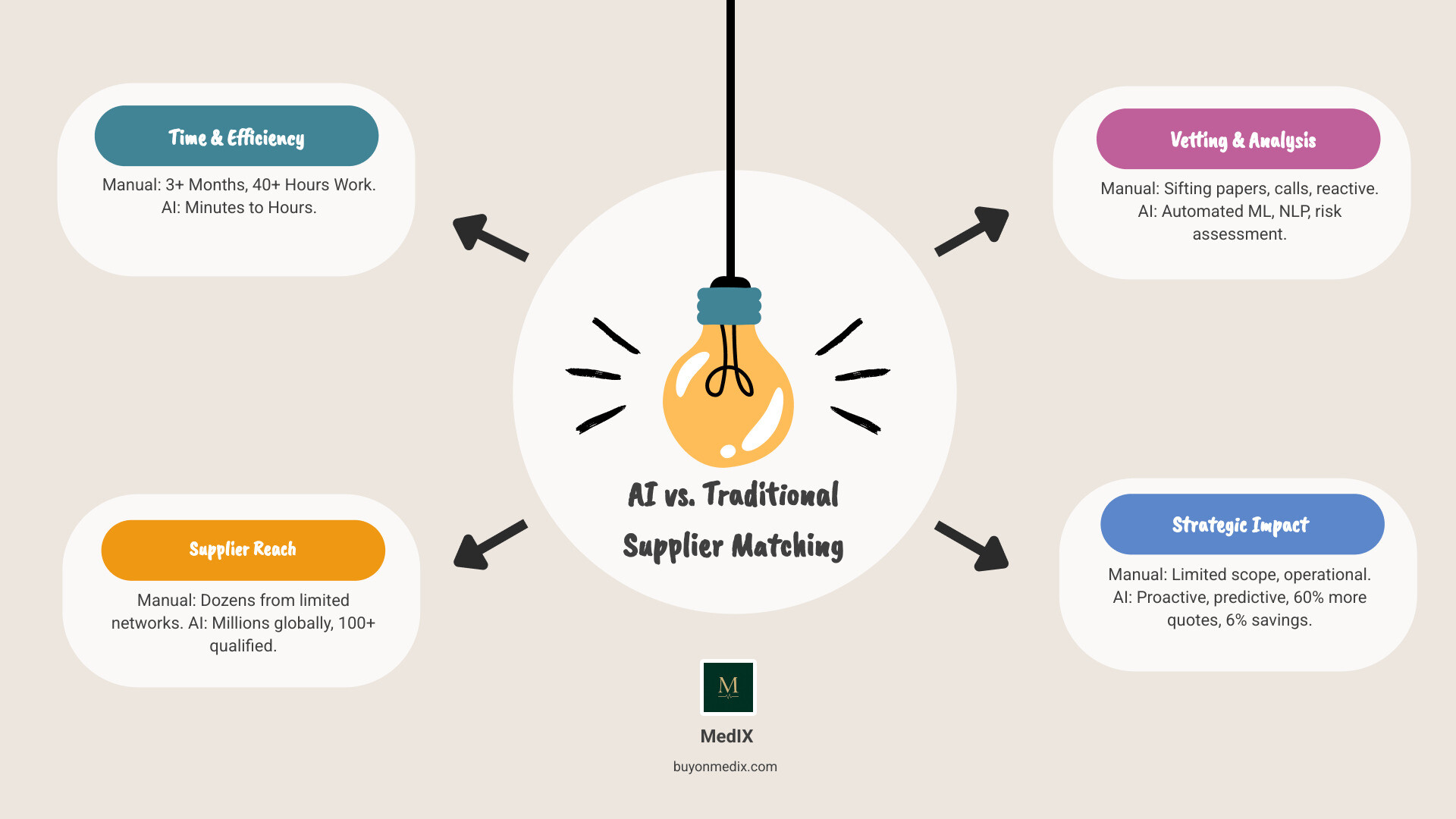
Traditional supplier sourcing is painfully slow. On average, a manual supplier search takes about three months and over 40 hours of work, yet considers only a few dozen suppliers from thousands of potential options. For healthcare procurement managers dealing with urgent equipment needs, compliance requirements, and global logistics challenges, this simply doesn't cut it anymore.
AI is reshaping this landscape. Organizations using AI-powered supplier recommendations receive an average of 60% more quotes per sourcing event compared to manual methods. More importantly, they save an extra 6% when leveraging these recommendations—savings that directly impact patient care budgets.
This guide walks you through everything you need to know about AI supplier matching: how it works, why it matters for healthcare procurement, the tangible benefits you can expect, and practical steps to implement it in your organization—even if you're working with legacy systems.
The Evolution of Supplier Findy: From Manual to Intelligent
Once upon a time, finding a new supplier was an arduous quest. Procurement professionals relied on manual research, networking at trade shows, or the good old word-of-mouth. Imagine flipping through physical catalogs, making countless phone calls, and sifting through stacks of paper ledgers just to find a handful of potential partners. It was a time-consuming, labor-intensive process with a severely limited scope, often leaving organizations reactive to market changes rather than proactive. The introduction of digital databases in the late 20th century marked a significant shift, offering a more structured, albeit still static, way to store and retrieve supplier information.

These traditional methods, while foundational, were inherently inefficient as global supply chains expanded and became more complex. The challenges were clear: identifying new suppliers was slow, vetting them was inconsistent, and the sheer volume of potential partners made comprehensive findy nearly impossible. This often led to reliance on existing, perhaps suboptimal, suppliers and a constant exposure to supply chain disruptions.
Then came the AI shift. With artificial intelligence, we moved from a reactive approach to a proactive one. Instead of simply reacting to shortages or seeking replacements for underperforming suppliers, AI allows us to continuously scan the market, anticipate needs, and identify optimal partners before a crisis hits. This proactive findy is powered by sophisticated semantic analysis, which goes far beyond simple keyword searches to truly understand the nuances of your procurement needs.
AI leverages vast amounts of data to identify and vet suppliers with unprecedented speed and accuracy. It works by aggregating data from countless sources—internal systems, public databases, news feeds, financial reports, and even social media. Natural Language Processing (NLP) and machine learning algorithms then process this data, identifying patterns, assessing risks, and ultimately matching your requirements with the most suitable suppliers. This means we can scan millions of suppliers in just hours or days, not months.
However, the power of AI hinges on one crucial element: clean data. As the old adage goes, "Garbage In, Garbage Out." Without accurate, reliable, and well-structured data, even the most advanced AI tools cannot provide meaningful insights. This underscores the importance of data quality, integration, and governance—a topic we'll dive deeper into shortly. For more on how we manage the intricate web of healthcare suppliers, check out our insights on Healthcare Supply Chain Management.
From Keywords to Context: How AI Understands Your Needs
Think about how you typically search for something online. You type in keywords and hope for the best. While this works for everyday queries, procurement is far more complex. Keyword matching alone falls short because it often misses the subtle meanings, technical specifications, and strategic context embedded in your requests. It's like asking for "round things" when you actually need "spherical medical implants for orthopedic surgery"—a big difference!
This is where semantic search and Natural Language Processing (NLP) revolutionize AI supplier matching. Instead of just looking for exact word matches, NLP algorithms are trained to understand the meaning and intent behind your words. They can analyze unstructured data—such as detailed Requests for Quotation (RFQs), technical specifications, emails, and even chat transcripts—to extract and categorize key information. For example, an AI tool can analyze requirements expressed in natural language to find compatible supplier solutions, moving beyond simple keyword matching to deep semantic analysis that understands technical, commercial, and strategic context. This capability is crucial for identifying niche suppliers or those with specialized capabilities that might otherwise be overlooked. With artificial intelligence, find new suppliers in days, not months.
By understanding context, AI can identify suppliers with similar capabilities even if they don't produce the exact required item, which proved incredibly valuable during the COVID-19 crisis for finding alternative sources for critical medical supplies. This iterative training of NLP algorithms with category expert input is key to the precision of AI supplier matching, ensuring that the recommendations are not just relevant, but truly optimal for your unique needs.
The Foundation: Why Clean Data is Non-Negotiable
We've all been there: trying to make sense of scattered information, contradictory records, and outdated files. In procurement, this often manifests as data silos—information trapped in different departments or legacy systems—and inconsistent data formats. These issues are not just annoying; they can severely limit the performance of any AI supplier matching system. If the data fed into the AI is messy, incomplete, or inaccurate, the insights it generates will be, too.
This is why clean data is absolutely non-negotiable. It's the bedrock upon which effective AI-driven supplier findy is built. Data cleansing involves identifying and correcting errors, removing duplicates, and standardizing formats across all your data sources. Once clean, data integration becomes paramount. We need to seamlessly connect data from various systems, such as Enterprise Resource Planning (ERP) systems, Customer Relationship Management (CRM) platforms, and external market intelligence sources.
Building a "single source of truth" for supplier data ensures that every part of your organization is working with the same, accurate information. This unified data model provides a holistic view of your suppliers, encompassing their performance, compliance, risk profiles, and capabilities. Without this foundational step, our AI tools can't provide the meaningful insights needed for informed decision-making. That's why we emphasize meticulous data collection, cleaning, and consolidation. For more information on how we manage procurement data, you can visit our Hospital Procurement Platform page.
Core Benefits and Strategic Use Cases of AI Supplier Matching
The promise of AI supplier matching isn't just about fancy technology; it's about delivering tangible, measurable benefits that transform procurement from a cost center into a strategic value driver. Our customers who accept AI-powered supplier recommendations aren't just getting more quotes; they're saving money and operating more efficiently. They receive an average of 60% more quotes per event, leading to an extra 6% in savings. These aren't small numbers—they represent significant improvements to your bottom line and, in healthcare, directly impact our ability to deliver quality patient care.

The core benefits we observe include:
- Speed: What once took months now takes days or even hours. AI rapidly scans, identifies, and shortlists suppliers, dramatically accelerating the sourcing cycle.
- Accuracy: By analyzing vast datasets and understanding contextual nuances, AI provides highly relevant and precise matches, reducing the risk of human error.
- Cost Savings: More competitive bidding, better negotiation positions, and optimized supplier selection directly translate into significant cost reductions.
- Strategic Alignment: AI frees up procurement teams from manual tasks, allowing them to focus on strategic initiatives like risk management, innovation, and sustainability.
These benefits aren't just theoretical; they translate into real-world strategic advantages for organizations.
Opening up Efficiency and Cost Savings
Imagine a world where you no longer spend hours on repetitive, administrative tasks. That's the world AI supplier matching helps create. With automated outreach, AI can identify dozens of qualified suppliers and automate the initial contact and reminders, surpassing manual methods that typically involve contacting only 3-5 suppliers. This drastically reduces manual effort, freeing up your team to focus on more strategic activities.
The result? Faster cycle times. Automation can speed up the entire procurement cycle by 40% or more, meaning you can get critical medical equipment and supplies when you need them, faster. This efficiency also translates to better negotiation power. With a wider pool of qualified suppliers and instant access to market intelligence, you're always in a stronger position to negotiate favorable terms. AI also fosters competitive bidding by enabling you to attract more suppliers, ensuring you get the best value.
Furthermore, AI is excellent for managing tail spend—the large volume of low-value, often unmanaged, purchases that can cumulatively add up to significant costs. AI-powered sourcing platforms can automate thousands of small sourcing events, bringing structure and savings to an area traditionally difficult to control. Our goal is to help you find savings quickly, often within 48 hours, with zero setup and instant ROI. For a deeper dive into how smart comparisons lead to better deals, explore our Medical Equipment Price Comparison insights.
Enhancing Supply Chain Resilience and Risk Management
In an unpredictable global landscape, supply chain resilience is paramount, especially in healthcare. AI supplier matching is a game-changer here, offering proactive risk assessment rather than reactive damage control. AI continuously monitors thousands of data sources—financial reports, news feeds, government databases, and geopolitical analyses—to provide early warning signals of potential supplier distress, such as financial instability, geopolitical risks in their region, or regulatory changes.
This predictive capability allows us to act before a problem escalates. If a key supplier shows signs of instability, AI tools can be activated to quickly find equivalent alternatives, reducing the risk of production stoppage or critical shortages. This is essential for diversifying the supply base and reducing dependency on single suppliers for critical parts, a key vulnerability exposed during recent global events.
McKinsey research highlights that top performers using AI can achieve 20 to 50 percent less exposure to key risks such as reliance on single suppliers. The ability to find alternative suppliers quickly, sometimes identifying over 30 high-potential suppliers in less than a week during a crisis, means we can maintain continuity of operations and ensure that patient care remains uninterrupted. Building a diversified and reliable supplier network through AI is not just good practice; it's a strategic imperative. To learn more about how we connect buyers with a global network of verified suppliers, visit our page on Global Medical Device Distributors.
Driving Strategic Procurement Goals
Beyond efficiency and risk management, AI supplier matching is a powerful tool for advancing strategic procurement goals that align with modern organizational values. Two significant areas are supplier diversity and sustainability.
AI allows us to identify and prioritize certified diverse suppliers, supporting initiatives that promote inclusivity and economic equity. By leveraging AI-powered findy databases, we can expand our search beyond traditional networks to include suppliers from underrepresented groups, helping organizations meet their diversity, equity, and inclusion (DEI) objectives.
Similarly, with increasing global focus on environmental responsibility, AI can help us find suppliers with strong sustainability practices and achieve Environmental, Social, and Governance (ESG) goals. AI tools can analyze sustainability reports, certifications, and public records, automatically calculating ESG scores for potential partners. This enables us to make informed decisions that not only benefit our bottom line but also contribute to a greener, more ethical supply chain. The Association for Health Care Resource & Materials Management (AHRMM) offers valuable resources for assessing supplier performance in green initiatives, reinforcing the importance of sustainable procurement strategies. For more information, refer to The Association for Health Care Resource & Materials Management. AI can also support local sourcing initiatives, connecting organizations with regional suppliers to boost local economies and reduce logistical footprints.
A Practical Guide to Implementing AI in Your Procurement Process
Adopting AI supplier matching might sound like a huge undertaking, but it doesn't have to be. We view it as a journey, not a sprint. A phased implementation approach, coupled with robust change management strategies, is key to successful integration. It's about empowering your team, not replacing them, and ensuring that everyone understands the benefits and how to leverage these powerful new tools. Gaining buy-in from all stakeholders, from procurement managers to IT, is crucial for a smooth transition.
Integrating AI into procurement processes means reimagining and recreating workflows that may have been ingrained for years or even decades. This often requires leadership to communicate the long-term benefits clearly and provide adequate training and support. Our goal is to make this transition as seamless as possible, turning potential resistance into enthusiastic adoption. For insights into how AI is being integrated into medical procurement specifically, visit our AI Medical Procurement page.
Step-by-Step Integration Roadmap
We recommend a "Crawl-Walk-Run" approach to implementing AI supplier matching:
- Define Objectives and Requirements (Crawl): Before diving into technology, clearly outline what you want to achieve. Are you aiming for cost reduction, improved risk management, improved supplier diversity, or faster sourcing cycles? Defining specific, measurable goals will guide your entire implementation.
- Assess Current Systems and Data (Crawl): Take stock of your existing procurement systems, data quality, and integration capabilities. Identify data silos and areas where data cleansing is needed. This assessment helps determine what AI tools will integrate best and what foundational work is required.
- Choose Suitable AI Technologies (Walk): Select AI tools that align with your defined objectives and integrate seamlessly with your existing infrastructure. This might involve machine learning for predictive analytics, NLP for contextual search, or generative AI for automated document creation. Some platforms, for example, are built from the ground up with AI as their foundation, offering modern interfaces and speed.
- Prioritize Process Automation and Pilot Projects (Walk): Start small. Identify repetitive tasks that can be automated first, such as invoice processing, supplier scoring, or qualification assessments. Launch pilot projects with clear, measurable outcomes to demonstrate early success and build momentum.
- Train Your Team (Walk): Provide comprehensive training for your procurement team. Equip them with the necessary skills to effectively use the new AI tools, interpret AI outputs, and leverage data-driven insights for strategic decision-making. Data literacy and change management skills are vital here.
- Monitor and Optimize Performance (Run): AI isn't a "set it and forget it" solution. Continuously review AI-driven processes using Key Performance Indicators (KPIs) to measure effectiveness. Track metrics like supplier delivery reliability, risk mitigation rates, and cost savings. Based on these insights, refine and improve your systems for continuous improvement.
Overcoming Common Challenges in AI Adoption
While the benefits of AI are compelling, we understand that integrating new technologies comes with its share of problems. Being aware of these challenges and having strategies to address them is crucial for successful adoption:
- Data Quality and Silos: As we discussed, inconsistent or fragmented data severely limits AI's performance. The solution involves establishing strong data governance, investing in data cleansing tools, and integrating data from disparate sources into a centralized, AI-ready system.
- Integration with Legacy Systems: Many organizations, especially in healthcare, operate with older procurement and supply chain platforms that weren't built for AI. This can lead to compatibility issues. A phased approach, starting with small-scale AI applications like invoice automation, can help bridge the gap and demonstrate value before a full overhaul.
- Internal Skills Gaps: AI tools require new skills to operate and interpret effectively. We can address this by investing in targeted training programs for existing procurement teams or collaborating with external AI specialists.
- Data Security and Privacy: Supplier data often includes sensitive information. AI adoption introduces risks related to regulatory compliance and data privacy. It's imperative to ensure AI algorithms comply with relevant standards and incorporate safeguards like data encryption and access controls. Regular audits help identify vulnerabilities and protect sensitive information.
- Algorithmic Bias: AI models learn from the data they're fed. If that data contains historical biases, the AI might perpetuate them. We must prioritize algorithmic fairness by using diverse datasets, regularly auditing algorithms for bias, and maintaining human oversight.
- Resistance to Change: People are naturally wary of new technologies. Clear communication about the benefits, involving employees in the implementation process, and providing adequate training can help overcome resistance and foster a culture of adoption.
As Deloitte points out, "Moving to the cloud requires reimagining and recreating workflows that have been ingrained in the healthcare business for years or decades." This sentiment applies equally to AI, but the benefits—from improved staff productivity to a positive return on investment—make it a worthwhile endeavor. For a deeper dive into these challenges and their solutions, refer to o help staff navigate the digital world Challenges and Solutions in Implementing Cloud and AI.
The Future of Supplier Findy and Management
The landscape of supplier findy and management is constantly evolving, and AI is at the forefront of this change. Looking ahead, we anticipate a future characterized by hyper-automation, sophisticated predictive capabilities, and a fundamental shift in how procurement is perceived within organizations. This is not just about incremental improvements; it's about a complete reimagining of the procurement function.
The future outlook includes a move towards hyper-automation, where AI and other advanced technologies automate an even broader range of procurement tasks, from contract management to invoice processing, seamlessly. We'll see the rise of "digital supplier twins"—virtual models of suppliers that allow us to test scenarios, predict performance, and assess risks in a simulated environment before making real-world decisions. Prescriptive analytics will go beyond simply reporting on what happened or predicting what might happen, to suggesting specific actions and strategies, such as switching suppliers or renegotiating terms.
This technological evolution signifies a strategic shift: procurement will increasingly be seen as a core value driver, moving away from being a purely operational function. By leveraging AI, procurement teams will lift their role, becoming strategic advisors who contribute directly to innovation, resilience, and competitive advantage. For more information on the broader impact of AI in medicine, explore our insights on AI in Medicine.
The Rise of Generative AI in Supplier Matching
While traditional AI excels at pattern recognition and predictive analysis, Generative AI (GenAI) brings a new level of sophistication and creativity to AI supplier matching. It goes beyond merely processing existing data; it can synthesize unstructured data and generate new insights and content.
Imagine GenAI capable of:
- Synthesizing Unstructured Data: GenAI can process and understand vast amounts of unstructured data—news articles, social media, reviews, and even complex technical documents—to create comprehensive supplier profiles and identify subtle risks or opportunities that traditional AI might miss.
- Scenario Modeling: GenAI can create simulated scenarios to prepare procurement teams for different negotiation outcomes, anticipate market shifts, or suggest alternative sourcing plans in response to geopolitical tensions or production halts. This allows for proactive planning and risk mitigation.
- Conversational Queries: Users can interact with GenAI using natural language, asking complex questions about supplier capabilities, market trends, or risk factors and receiving instant, contextually relevant answers.
- Creative Supplier Exploration: GenAI can suggest new, unconventional supplier categories or geographical regions that might offer innovative solutions, moving beyond established networks.
- Automated RFX Creation: GenAI can automate the creation of essential procurement documents like Requests for Information (RFIs), RFQs, and Requests for Proposals (RFPs), designing customized templates based on category, supplier, or region, and extracting and validating data from submitted documents.
GenAI truly improves AI supplier matching capabilities by offering a more dynamic, contextual, and creative approach, changing how we find, evaluate, and engage with suppliers.
The Role of Blockchain in Building Trust
In the pursuit of truly resilient and transparent supply chains, particularly in healthcare, blockchain technology offers a compelling solution. While not directly an AI supplier matching tool, its integration with AI platforms can significantly improve trust and verification throughout the procurement process.
Blockchain technology provides:
- Improved Transparency: By creating an immutable, distributed ledger, blockchain offers unparalleled transparency. Every transaction and data point related to a supplier, from origin to delivery, can be recorded and verified.
- Data Immutability: Once data is recorded on a blockchain, it cannot be altered without detection. This feature protects against data manipulation, ensuring the integrity and reliability of supplier information.
- Secure Data Storage: Blockchain's decentralized architecture means data is distributed across a network of computers, making it extremely difficult to hack or compromise compared to centralized databases.
- Improved Traceability: Blockchain enables both upstream and downstream visibility. We can track medical supplies from manufacture through every step of the supply chain, authenticating the origin of products and ensuring their legitimacy. This is critical for combating counterfeit goods and ensuring patient safety.
The healthcare industry stands to greatly benefit from the increased privacy, transparency, and accessibility that blockchain technologies provide. By integrating blockchain with AI, we can build a highly secure, transparent, and trustworthy ecosystem for medical procurement, ensuring that every piece of equipment is verified and every transaction is transparent. For more on how blockchain improves trust, explore insights on increased privacy, transparency, and accessibility.
Conclusion
We've journeyed through the intricate world of AI supplier matching, from its humble beginnings in manual research to its current state as a sophisticated, data-driven powerhouse. It's clear that AI is no longer a futuristic concept but a strategic imperative for modern procurement, especially in the demanding healthcare sector.
The key takeaways are profound: AI drives unprecedented efficiency, improves supply chain resilience against unforeseen disruptions, and fosters innovation in how we find and manage our supplier relationships. It empowers procurement teams to move beyond administrative tasks, focusing instead on strategic initiatives that deliver real value. The future of procurement is intelligent, proactive, and deeply integrated with advanced technologies.
At MedIX, we are committed to leveraging the full potential of AI to revolutionize medical procurement. Our platform uses AI-matching, rigorous compliance checks, and reliable global logistics to connect certified medical equipment suppliers with hospitals and clinics worldwide, ensuring verified equipment and transparent transactions. We believe that by embracing AI, we can help build smarter, more resilient, and ultimately, more effective healthcare supply chains globally.

Expert voices
Insights from leaders transforming medical equipment procurement


More from our blog
Discover the latest trends in medical technology and procurement

Stay ahead of medical technology
Get the latest insights, research, and market updates delivered straight to your inbox
Ready to transform your procurement
Discover how MedIX can streamline your medical equipment sourcing process