Transforming medical equipment procurement globally


Why Healthcare Procurement Needs AI Now
AI medical procurement uses artificial intelligence to automate and optimize how healthcare organizations source, evaluate, and purchase medical supplies and equipment. Here's what it means for your organization:
Key Applications of AI in Medical Procurement:
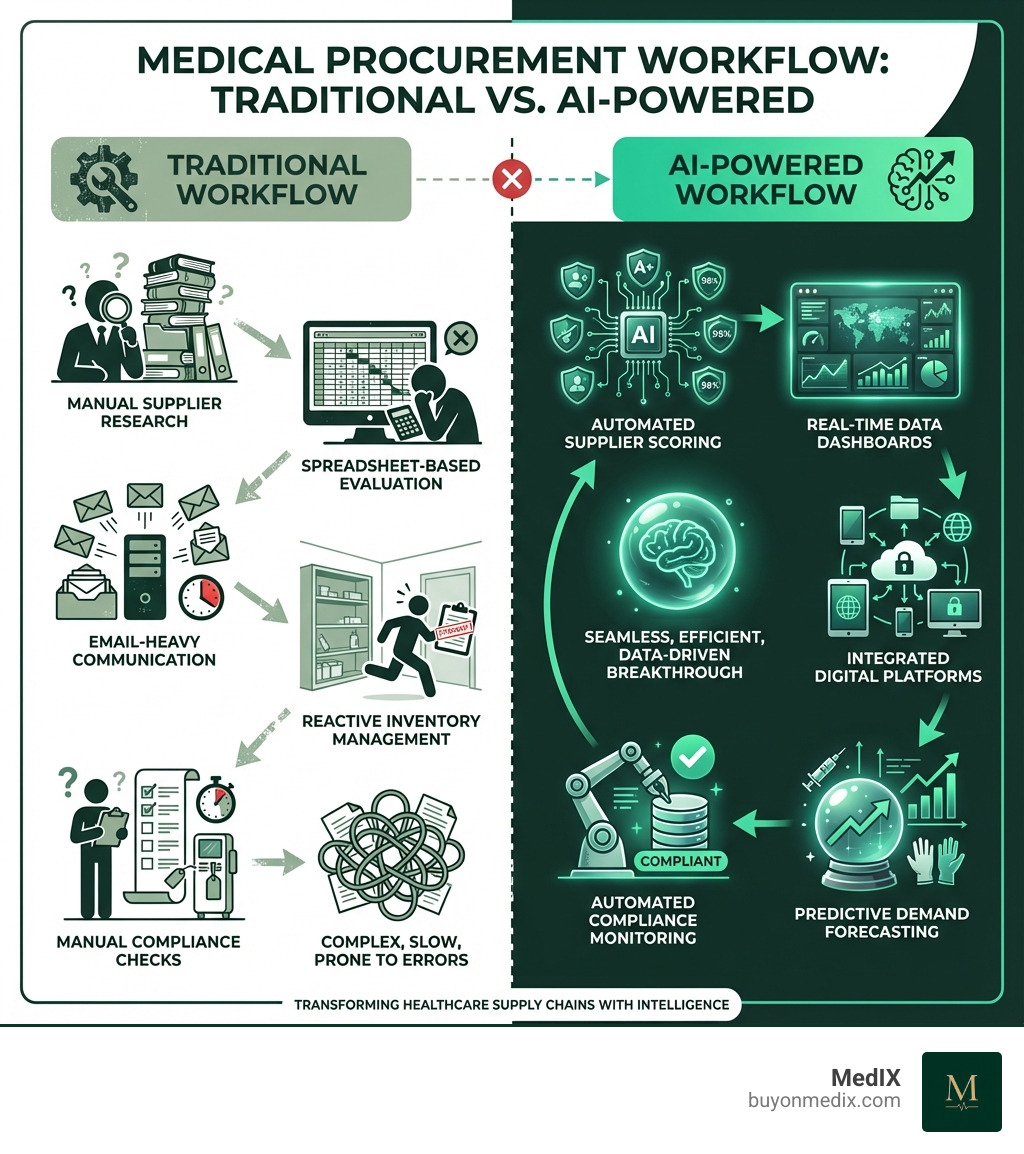
- Automated supplier evaluation - AI analyzes vendor performance, risk profiles, and pricing trends in seconds
- Demand forecasting - Predictive analytics prevent stockouts and reduce waste by analyzing historical data and real-time trends
- Contract compliance - Automated systems flag non-compliant purchases and redirect orders to approved suppliers
- RFx automation - AI generates due diligence questions and evaluation criteria, saving 250+ hours per project
- Spend analytics - Real-time dashboards identify cost-saving opportunities across your supply chain
If you've ever spent weeks manually vetting suppliers or struggled with a spreadsheet full of procurement data, you're not alone. One healthcare procurement leader described spending a decade managing "multi-million dollar healthcare contracts using Excel spreadsheets, brochures, and disorganized boardroom meetings." This frustration led to the founding of AI-powered procurement platforms.
The healthcare sector faces mounting pressure. Rising costs, supply chain disruptions, and regulatory demands create a perfect storm. Traditional manual procurement processes can't keep pace.
The reality is stark: 74% of healthcare organizations are already leveraging AI to boost supply chain efficiency and savings. Those who wait risk falling behind competitors who are automating workflows, preventing stockouts, and securing better supplier terms.
AI isn't replacing procurement professionals—it's freeing them from administrative burden. While AI handles data analysis and routine tasks, your team can focus on strategic relationships, complex negotiations, and patient-centered decisions.
The shift from "black box" complexity to breakthrough results starts with understanding how AI transforms each stage of your procurement cycle.
The Tangible Benefits: Why Adopt AI in Medical Procurement?
The promise of AI in healthcare procurement isn't just about buzzwords; it's about delivering concrete, measurable benefits that impact our bottom line and, more importantly, patient care. We're talking about significant cost savings, unprecedented efficiency gains, and truly informed decision-making. Imagine a world where your procurement team isn't just reacting to crises, but proactively optimizing every aspect of your supply chain. This is the world that AI medical procurement is building.

AI-driven analytics and data visualization offer us deeper insights into healthcare spending patterns, allowing us to pinpoint cost-saving opportunities that were once hidden in mountains of data. By changing raw data into actionable intelligence, we can make smarter, faster, and more clinically informed choices. The statistics speak for themselves: 92% of organizations are achieving positive results with AI, a testament to its transformative power. This isn't just about saving money; it's about building a more resilient and responsive healthcare supply chain.
Boosting Efficiency and Slashing Costs
One of the most immediate and compelling benefits of integrating AI into our procurement processes is the dramatic boost in efficiency and the resulting cost reductions. We've all experienced the tedious, time-consuming nature of manual administrative tasks. AI changes this entirely.
AI can help healthcare procurement teams automate these administrative tasks and streamline workflows, freeing up valuable human resources. For example, AI-powered platforms can save us over 250 hours of research on every RFx (Request for X), accelerating the market analysis process and the evaluation of supplier submissions. Think about that: 250 hours per project! That's a game-changer for our teams.
Beyond mere automation, AI actively identifies opportunities for financial optimization. In 2023, AI technology helped identify rebate processing optimization opportunities and other important contract implications, resulting in an impressive $18 million in annualized savings for customers. These aren't just one-off savings; they're systemic improvements that continuously reduce our operational costs. Furthermore, AI has the power to prevent critical disruptions. One feature alone prevented over 200,000 stockout situations in 2023, safeguarding patient care and avoiding costly emergency purchases. This proactive approach to inventory management and demand forecasting directly translates into significant cost reductions and improved operational fluidity.
Enhancing Strategic Decision-Making
AI doesn't just make us faster; it makes us smarter. By analyzing vast datasets in real-time, AI provides us with the insights needed for truly improved strategic decision-making. This means we can move beyond gut feelings and make choices based on objective, data-driven criteria.
For instance, AI solutions can accelerate the evaluation of supplier submissions, improving objectivity and efficiency. This leads to better supplier selection based on performance, pricing trends, and risk profiles. AI also plays a crucial role in ensuring contract compliance. A single AI feature automatically redirected over 40,000 purchases that would have otherwise broken contract compliance. This capability ensures we adhere to our agreements, avoid penalties, and leverage negotiated pricing, further contributing to cost savings and reducing non-file spend.
This ability to monitor and enforce compliance, coupled with robust data analysis, empowers us to make proactive risk management decisions. We can identify potential supply chain disruptions before they escalate, allowing us to implement mitigation strategies. With AI, we gain an unparalleled level of transparency and control over our procurement activities, leading to more resilient supply chains and ultimately, better patient outcomes.
How AI is Revolutionizing Medical Procurement Today
The change brought about by AI in medical procurement is profound, shifting our operations from reactive to predictive, and from manual to intelligent. We're seeing machine learning (ML) and generative AI (GenAI) at the forefront of this revolution, optimizing workflows and enabling strategic sourcing like never before. These advanced technologies are not just tools; they are strategic partners in navigating the complexities of healthcare supply chains.

AI and, notably, generative AI, are among the top digital supply chain investment priorities across industries, and for good reason. They allow us to move beyond simple automation to truly intelligent management of our resources. From precise demand forecasting to intelligent supplier selection and robust contract management, AI is reshaping how we acquire the critical supplies our healthcare organizations need.
AI-Powered Demand Forecasting and Inventory Management
One of the most critical areas where AI delivers immense value is in demand forecasting and inventory management. Historically, predicting the need for medical supplies has been a complex, often inaccurate, endeavor, leading to costly overstocking or dangerous shortages. AI changes this equation entirely.
AI-powered tools enable precise demand forecasting by analyzing historical data, real-time trends, seasonal fluctuations, and even external factors like public health advisories or weather patterns. This sophisticated analysis allows us to predict future needs with remarkable accuracy, ensuring we have the right products in the right quantities at the right time. The impact is tangible: we can prevent shortages, reduce waste from expired or unused products, and optimize our stock levels, leading to significant cost savings and improved patient safety. As we've seen, this feature alone prevented over 200,000 stockout situations in 2023, a clear demonstration of AI's ability to maintain continuity of care.
By leveraging machine learning, these systems continuously learn from our purchasing behaviors and market dynamics, making their predictions even more refined over time. This dynamic adaptation means our inventory management becomes a living system, constantly optimizing itself to meet evolving demands.
Intelligent Supplier Selection and Performance Monitoring
The process of selecting suppliers and monitoring their performance has historically been resource-intensive and prone to human bias. AI brings a new level of intelligence, objectivity, and efficiency to this crucial aspect of medical procurement.
AI solutions can accelerate the evaluation of supplier submissions, improving objectivity and efficiency. They perform automated vendor evaluation by analyzing vast amounts of data, including past performance, pricing trends, certifications, compliance history, and even public sentiment or news. This comprehensive risk profile analysis allows us to identify the most reliable and cost-effective partners while mitigating potential risks.
Beyond initial selection, AI continuously monitors supplier performance, tracking delivery times, product quality, adherence to terms, and responsiveness. This constant performance trend identification allows us to proactively address issues, negotiate better terms, and foster stronger, more strategic relationships with our key suppliers. Furthermore, AI can automate contract management, ensuring that agreements are up-to-date, terms are met, and compliance is maintained. This capability is vital, as evidenced by the redirection of over 40,000 non-compliant purchases, ensuring that every transaction adheres to our contractual obligations and maximizes value. AI helps us increase catalogue purchases to reduce non-file spend and improve contract compliance, strengthening our purchasing power and operational integrity.
Your 5-Step Playbook for Implementing AI in Procurement
Embracing AI in medical procurement isn't an overnight flip of a switch; it's a strategic journey that requires a thoughtful, phased implementation. We need an actionable strategy, careful change management, and strong stakeholder buy-in to open up its full potential. Think of this as our playbook for integrating AI into our procurement processes, changing them for the better.
The key is to approach this with an iterative mindset, learning and adapting as we go. By focusing on practical steps, we can ensure that our investment in AI yields significant returns, not just in efficiency and cost savings, but in building a truly resilient and intelligent supply chain.
Step 1: Assess Your Data and Define Your Goals
Before we can even think about AI tools, we must first look inward. The foundation of any successful AI implementation is high-quality data. We need to conduct a thorough data quality assessment, identifying any data silos, inconsistencies, or gaps that could hinder AI's effectiveness. How are we cleansing, synthesizing, and maintaining our data? Do we have the data integrity and common structure to build advanced analytics? This step is critical because AI is only as good as the data it's fed.
Simultaneously, we must clearly define our goals. What specific problems are we trying to solve with AI? Are we aiming for cost reduction, improved efficiency, better supplier relationships, or improved supply chain resilience? By setting clear, measurable objectives, we can focus our efforts and prioritize high-value use cases. For example, we might start by focusing on areas where AI can make the biggest immediate impact, such as automating repetitive administrative tasks or optimizing demand forecasting for critical supplies. Robust data governance practices must be established from the outset, especially given the sensitive nature of healthcare data.
Step 2: Choose the Right AI Tools and Partners
With our data assessed and goals defined, the next step is to identify the AI tools and partners that best align with our needs. The market is full of AI solutions, from specialized applications to end-to-end platforms that automate workflows, analyze large datasets, and deliver actionable insights.
When evaluating AI platforms, we should look for solutions that offer comprehensive capabilities, such as machine learning for predictive analytics and generative AI for automating document creation and analysis. It's crucial to consider how these new tools will integrate with our existing Enterprise Resource Planning (ERP) systems and other procurement software. Scalability is another key factor; the chosen solution should be able to grow with our organization's evolving needs. We also need to assess if the product meets regulatory standards and performs in line with the manufacturer's claims. For comprehensive guidance on this crucial step, we recommend consulting resources like A buyer's guide to AI in health and care, which outlines important questions to consider when procuring AI products for health and care.
Step 3: Run a Pilot Program for your AI medical procurement strategy
Instead of a big-bang approach, we advocate for starting small with a pilot program or proof-of-concept (PoC). This allows us to test the waters, gather initial results, and refine our strategy before a broader rollout. We should select a specific, contained area of our procurement process for the pilot – ideally one with low complexity but high potential value.
During the pilot, we'll focus on measuring initial ROI and gathering user feedback. This iterative and agile deployment allows us to quickly identify what works, what doesn't, and what adjustments are needed. For instance, we might pilot an AI tool for automating RFx creation or for precise demand forecasting of a single category of medical supplies. This hands-on experience provides invaluable insights and helps build confidence within our teams.
Step 4: Scale Up and Integrate Across the Organization
Once our pilot program demonstrates success and provides clear value, we can then develop a roadmap for scaling up and integrating AI across our entire procurement organization. This phase involves expanding the AI solution to more departments, categories, and processes.
Crucially, this step requires significant investment in staff training and development. Our teams need to understand how to interact with AI tools, interpret their insights, and leverage them to improve their work. Strong change management is essential here; we must ensure that staff understand AI augments, not replaces, their jobs. We'll build out the necessary infrastructure to support the expanded AI capabilities and drive adoption through continuous communication of benefits and success stories. It’s about creating a culture where AI is seen as a powerful assistant, empowering our professionals to focus on strategic initiatives and complex problem-solving.
Step 5: Measure, Monitor, and Optimize Continuously
The journey with AI is never truly finished. To ensure sustained success and maximize ROI, we must continuously measure, monitor, and optimize our AI-driven procurement processes. This involves tracking key performance indicators (KPIs) such as purchase price variance, maverick spend reduction, procurement cycle time, and on-time delivery rates.
By actively analyzing spend patterns and supplier performance data, we can identify new cost-saving opportunities and areas for further optimization. This continuous feedback loop allows us to refine our AI models, adapt to changing market conditions, and ensure our AI medical procurement strategy remains cutting-edge. Regular reviews and adjustments are vital to keep our AI solutions performing at their peak, ensuring they continue to deliver value and support our strategic objectives.
Navigating the Problems: Key Challenges and Risks
While the promise of AI in medical procurement is immense, we must also acknowledge and proactively address the challenges and risks that come with its adoption. Implementing new technologies is rarely without its problems, and AI, with its reliance on data and complex algorithms, presents its own unique set of considerations.
These challenges include ensuring the quality and security of our data, navigating ethical implications, and managing the significant investment required for implementation. By understanding these potential pitfalls, we can develop robust strategies to mitigate them, ensuring a smoother and more successful AI integration.
Overcoming Data Quality and Security Concerns
AI thrives on data, but it also highlights any deficiencies in our data management. Poor data quality – incomplete, inaccurate, or inconsistent information – can lead to flawed insights and misguided decisions. Therefore, a critical first step is data cleansing and normalization, ensuring that our data is accurate, consistent, and structured in a way that AI can effectively process. Maintaining data integrity is paramount throughout the AI lifecycle.
Beyond quality, data security is non-negotiable, especially in the sensitive healthcare sector. We must implement stringent cybersecurity protocols to protect patient and organizational data from breaches. This includes adhering to global data protection regulations and ensuring that AI systems are designed with privacy by design principles. When using AI for training, particularly with large language models (LLMs), it's crucial to employ proprietary systems that prevent external training on confidential information, safeguarding our sensitive data. Safeguarding privacy and ensuring compliance with regulations is not just a legal requirement but a fundamental ethical obligation.
Addressing Ethical and Workforce Considerations
The introduction of AI into our procurement teams naturally raises questions about ethics and the future of human roles. It's vital to frame AI's role correctly: AI augments human jobs, it doesn't replace them. By automating repetitive and data-heavy tasks, AI frees our procurement professionals to focus on higher-value activities such as strategic negotiations, complex problem-solving, and building stronger supplier relationships.
However, we must maintain human oversight in all AI-driven processes. AI should serve as an assistant, providing insights and recommendations, but the ultimate decision-making responsibility remains with our human experts. Transparency in AI decision-making is also key; we need to understand how AI arrives at its conclusions to trust and validate its output. Building an ethical AI culture involves clear guidelines, ongoing training, and open dialogue to ensure that AI is used responsibly, fairly, and in alignment with our organizational values and patient-centric mission. Strong change management is crucial to help staff understand that AI is a tool to empower them, not replace them.
Frequently Asked Questions about AI in Healthcare Procurement
How does AI improve patient care?
AI directly improves patient care by ensuring the continuous availability of critical supplies, preventing stockouts that could delay procedures or compromise treatment. It helps us source higher quality equipment through better vetting processes, ensuring our medical teams have the best tools. By freeing up staff from administrative burdens, AI allows them to focus more on patient-facing activities and clinical duties. By reducing errors and optimizing efficiency in the supply chain, AI contributes to a safer, more reliable, and ultimately higher standard of patient care.
Will AI replace procurement professionals?
No, AI is designed to augment human roles, not replace them. While AI excels at automating repetitive tasks, analyzing vast datasets, and providing predictive insights, it lacks human intuition, emotional intelligence, and the ability to build complex relationships or negotiate nuanced agreements. AI allows procurement professionals to focus on strategic initiatives, complex problem-solving, and relationship management. It improves human decision-making by providing data-driven insights, empowering our teams to be more strategic, efficient, and effective.
What is the typical ROI for implementing AI in procurement?
The Return on Investment (ROI) for implementing AI in procurement can be substantial and multifaceted. We often see significant cost savings through optimized pricing, reduced maverick spend, and efficient resource allocation. Increased efficiency is another major benefit, leading to faster procurement cycles and reduced administrative overhead. AI also drastically reduces stockouts and waste, which are major cost drivers in healthcare. Improved contract compliance ensures we maximize the value of our agreements and avoid penalties.
Key ROI metrics we track include:
- Purchase Price Variance (PPV)
- Maverick Spend Reduction
- Procurement Cycle Time
- On-Time Delivery Rate
These metrics help us quantify the tangible benefits and ensure our AI investments are delivering measurable value.
Conclusion
The journey from the "black box" of traditional, often opaque, procurement to the breakthrough clarity of AI medical procurement is not just an evolution; it's a strategic imperative for modern healthcare. We've seen how AI transforms every facet of our operations, from boosting efficiency and slashing costs to enhancing strategic decision-making and building resilient supply chains. By automating administrative tasks, preventing stockouts, and ensuring contract compliance, AI frees our teams to focus on what truly matters: delivering exceptional patient care.
The future of healthcare procurement is one where proactive strategies replace reactive measures, where data-driven insights guide every decision, and where our supply chains are agile, transparent, and robust. This isn't a distant dream; it's the present reality for organizations embracing AI.
At MedIX, we are at the forefront of this change, leveraging AI to connect certified medical equipment suppliers with hospitals and clinics worldwide. Our platform simplifies procurement through AI-matching, rigorous compliance checks, and reliable global logistics, ensuring verified equipment and transparent transactions. We believe that by embracing AI, we can collectively build a healthcare ecosystem that is more efficient, more resilient, and ultimately, better equipped to serve the needs of patients globally.
Explore our marketplace to see AI in action and join us in shaping the future of medical sourcing.

Expert voices
Insights from leaders transforming medical equipment procurement


More from our blog
Discover the latest trends in medical technology and procurement

Stay ahead of medical technology
Get the latest insights, research, and market updates delivered straight to your inbox
Ready to transform your procurement
Discover how MedIX can streamline your medical equipment sourcing process