Transforming medical equipment procurement globally


Why Medical Equipment Transaction Platforms Are Changing Healthcare Procurement
A medical equipment transaction platform is a digital marketplace that connects healthcare buyers (hospitals, clinics, practitioners) with sellers (manufacturers, distributors, refurbishers) to facilitate the buying and selling of medical devices and supplies. These platforms streamline procurement through features like:
- Verified sellers and certified equipment with compliance documentation
- AI-powered matching and comparison tools to find the right products
- Automated procurement workflows including RFQs, bulk ordering, and approval chains
- Integrated logistics and global shipping for reliable delivery
- Transparent pricing with contract-based and multi-tiered options
The global medical equipment market was valued at $512.3 billion in 2023 and is projected to grow at 6.1% annually through 2030. At the same time, the B2B eCommerce market is exploding—expected to reach $20.9 trillion by 2027, growing at 18.7% annually.
This convergence is driving a major shift in how medical equipment changes hands.
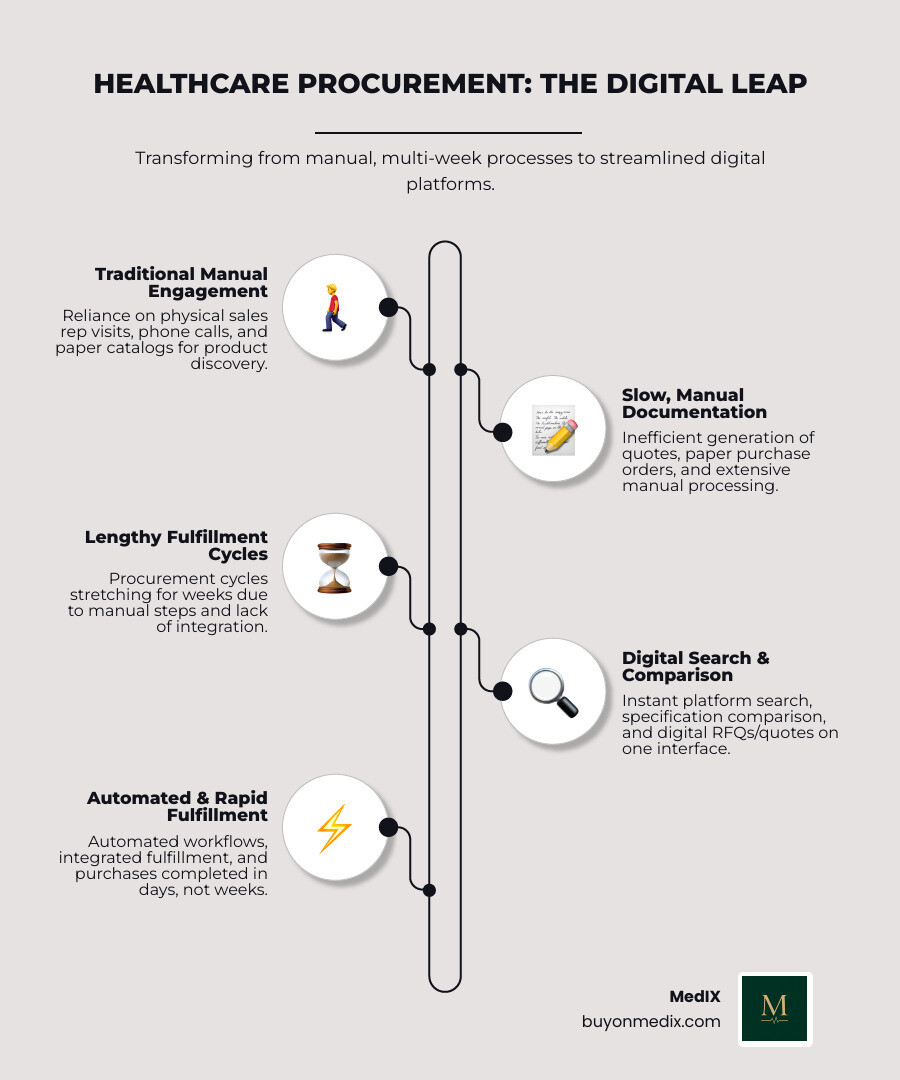
Gone are the days of sales representatives traveling from hospital to hospital with catalogs and clipboards, manually processing orders that take weeks to fulfill. That traditional model is inefficient, unscalable, and expensive. One medical supply platform reported that their clients saw +230% year-over-year sales growth after digitizing their procurement process.
Modern platforms are replacing this outdated approach with digital connection points that allow procurement managers to search thousands of products, compare specifications and prices, verify compliance documentation, and complete purchases—all from a single interface. A 2023 McKinsey study found that digitizing procurement with automated quote-to-order workflows can cut purchase cycle times by 60% and reduce error rates by 30%.
For procurement managers at global healthcare institutions, these platforms solve critical pain points: they simplify supplier vetting, ensure regulatory compliance, provide pricing transparency, and handle complex international logistics. Whether you're sourcing a new MRI machine from a manufacturer or finding certified refurbished surgical equipment, these platforms are becoming essential infrastructure for healthcare supply chains.
Core Features of a Modern Medical Equipment Transaction Platform
A modern medical equipment transaction platform is more than an online store; it is a structured B2B commerce ecosystem custom to the complex realities of healthcare. These platforms support the buying and selling of new and used medical equipment with a well-defined suite of features that streamline procurement, improve user experience, and expand global market access.
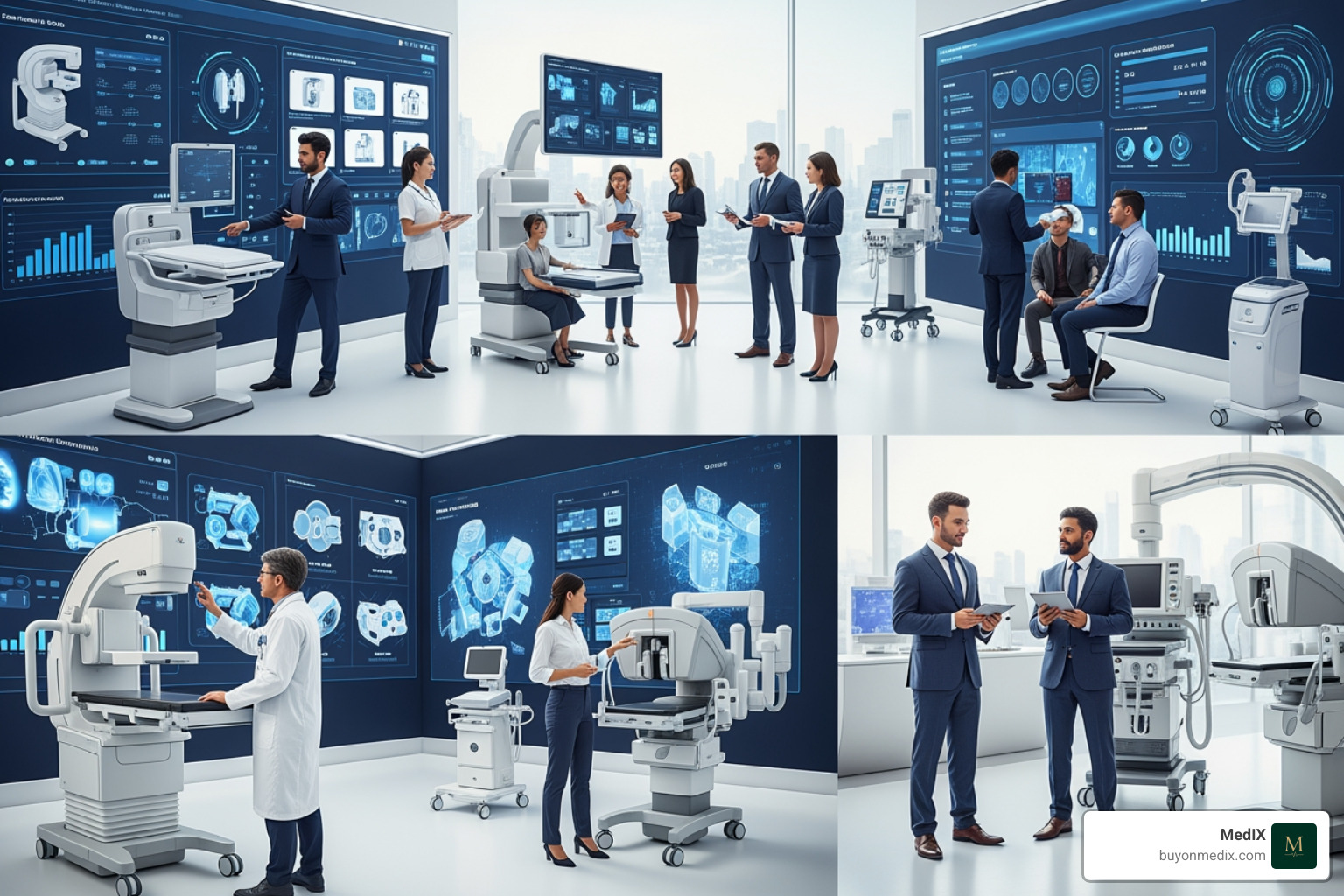
The volume of products available on leading platforms can reach hundreds of thousands of SKUs. This scale, combined with advanced digital capabilities, is what sets these marketplaces apart. As the B2B eCommerce market accelerates toward an anticipated $20.9 trillion by 2027, digitizing procurement has shifted from nice-to-have to operational necessity. Automated quote-to-order workflows that can cut purchase cycle times by 60% and reduce error rates by 30% illustrate how large the impact can be.
Essential B2B Commerce Capabilities
For businesses operating in the medical equipment e-commerce space, several capabilities are non-negotiable. Platforms must support intricate B2B relationships and strict regulatory demands.
Firstly, seamless ERP integration is essential. Connecting customers, pricing, and product data directly to the webstore saves time and reduces manual data entry errors. Our platform, for example, integrates with leading ERP systems, allowing for efficient data flow and consistent information across channels. Discover how MedIX integrates with your ERP.
Secondly, contract pricing and multi-tiered pricing are critical. Healthcare organizations often operate with negotiated rates, volume discounts, and framework agreements. A medical equipment transaction platform must enforce these pricing structures for different customer segments so that buyers always see their correct contract prices.
Thirdly, robust procurement controls and approval workflows are vital. These tools let hospitals and clinics set budgets, manage cost centers, enforce purchase order (PO) policies, and configure multi-step approvals before orders are finalized. This gives purchasing managers and finance leaders the control required to manage expenditure and prevent unauthorized buying.
Finally, sophisticated Product Information Management (PIM) is indispensable. Medical equipment demands detailed specifications, certifications, regulatory labels, and often multilingual documentation. A PIM system centralizes this information, keeping it accurate and accessible for every product, simplifying content management and supporting compliance efforts.
Empowering Buyers: Streamlined Procurement
For buyers, from large hospital networks to individual practitioners, the primary benefit of a medical equipment transaction platform is a streamlined, transparent procurement journey.
Platforms provide advanced search and filter functionalities that go beyond basic keyword matching. Buyers can filter by specialty, regulatory certification, equipment type, brand, price range, and condition (new, used, refurbished), among other criteria. This makes it possible to locate suitable products quickly, even within very large catalogs. Some platforms also use custom search rules and popularity signals to highlight the most relevant options.
AI-powered comparison of medical equipment tools further simplify decision-making. Instead of manually cross-referencing specifications from multiple vendors, buyers can compare features, prices, and compliance details side-by-side. This saves time and supports objective, data-driven purchasing decisions. You can explore more about this through our AI Smart Compare of Medical Equipment and Medical Equipment Price Comparison resources.
Quote management (RFQs) is another key feature. For large, custom, or project-based purchases, buyers submit a Request for Quote directly through the platform. Multiple suppliers can respond with offers, enabling structured, competitive bidding and clear pricing.
For recurring needs, platforms support bulk ordering tools and shopping lists. Hospitals can create pre-approved lists of frequently purchased items for different departments (for example, gynecology, surgery, or orthopedics), simplifying reordering and protecting supply continuity. Bulk reorder functions and CSV uploads make large-scale purchasing faster and less error-prone.
Maximizing Value for Sellers: Global Reach and Sales Tools
Sellers—from manufacturers and distributors to refurbishers—also gain significant value from a medical equipment transaction platform. These marketplaces provide a digital infrastructure that supports expansion, operational efficiency, and revenue growth.
Platforms offer digital storefronts where sellers can present their entire product catalog to a global audience, unconstrained by traditional sales territories. This leads to greater visibility and access to new markets and customer segments.
Integrated inventory management tools help sellers maintain accurate stock information, track availability, and update listings in real time. This reduces the risk of stockouts for critical items and supports reliable delivery promises. Features such as inventory per warehouse and distributed order routing can be used to optimize fulfillment.
Sales analytics and reporting give sellers visibility into buying behavior, product performance, and demand trends. Insights from order and customer reports support better forecasting, portfolio optimization, and more effective account management.
For marketing, platforms typically include tools like rewards and loyalty programs, customer segmentation for targeted campaigns, and content tools to create rich, informative product pages. Custom website design options and SEO-friendly listings improve online findability, making it easier for hospitals and clinics to find and evaluate the equipment on offer.
Comparing Platform Models and Specialized Services
The landscape of medical equipment transaction platforms is diverse, with models designed to accommodate different procurement strategies and budget levels. Some platforms focus primarily on new equipment, others specialize in the secondary market, and many combine both while adding specialized services to support complex transactions.
This diversity gives healthcare organizations multiple ways to optimize capital budgets and secure the specific equipment they need, whether that is a new imaging system or a certified refurbished device.
New vs. Used Equipment Marketplaces
A key strength of these platforms is their ability to connect the primary and secondary medical equipment markets.
New equipment marketplaces typically feature products from manufacturers and authorized distributors. Buyers gain access to the latest technologies, full warranties, and manufacturer-backed service options. This model works well for hospitals investing in cutting-edge devices or following strict standardization policies.
At the same time, demand for used and refurbished medical equipment remains high, especially where budgets are constrained or when equipping smaller facilities. Platforms that support the secondary market connect buyers with used equipment that has been professionally refurbished to meet established safety and performance standards. This enables organizations to purchase high-quality Durable Medical Equipment at significantly lower cost.
A single marketplace can serve as a hub for both new and refurbished devices, which is particularly useful for providers ranging from large hospitals to smaller Clinic Medical Supply operations that require flexibility in how they allocate spending.
Specialized Transaction Models: Auctions, Trade-Ins, and RFQs
Beyond simple fixed-price listings, many medical equipment transaction platforms support specialized transaction models that deliver additional flexibility and value.
Online auctions allow buyers to bid on equipment in real time. This can be an effective way to acquire specialized, surplus, or end-of-line items at competitive prices. For sellers, auctions provide a structured, time-bound mechanism to liquidate assets.
Equipment trade-in programs enable healthcare providers to exchange older devices for credit toward new purchases. Platforms coordinate these programs by connecting providers with refurbishers or secondary-market buyers, helping organizations manage asset lifecycles more efficiently.
The Request for Quote (RFQ) process is central to large and complex procurement. Buyers specify detailed requirements, and multiple sellers submit structured quotes in response. This supports transparent price findy and helps buyers secure favorable terms, particularly for bulk orders or projects involving installation and training. Platforms can layer RFQs with contract-based pricing, buyer-side approval workflows, and order attachments to capture all required compliance and authorization documents in one place.
The Future of Medical E-Commerce: Trends and Innovations
The medical equipment transaction platform ecosystem is evolving rapidly as technology advances and healthcare organizations demand more resilient, transparent supply chains. Emerging innovations are reshaping how equipment is sourced, evaluated, and delivered worldwide.
Key trends include deeper use of artificial intelligence, more sophisticated data analytics, greater emphasis on sustainability, and stronger cybersecurity to protect sensitive data. Together, these developments support smarter and more adaptive procurement.
The Role of AI in the Modern Medical Equipment Transaction Platform
Artificial Intelligence is becoming a core capability in next-generation medical equipment transaction platforms. Its ability to process large datasets and identify patterns is changing several aspects of procurement.
AI-powered product matching and smart comparison tools help buyers quickly identify equipment that fits their clinical, technical, and budgetary needs. Our platform uses AI to align buyer requirements with suitable products based on specifications, certifications, and cost, improving both speed and accuracy. Learn more about our approach to AI Medical Procurement and AI Smart Compare of Medical Equipment.
Predictive analytics for inventory management enables sellers to anticipate demand, align stock levels, and reduce shortages of critical supplies. By analyzing historical orders and broader market signals, AI supports better allocation of inventory across warehouses.
Automated quote-to-order workflows powered by AI streamline each step of the purchasing process. As highlighted by a McKinsey study, these workflows can cut purchase cycle times by around 60% and reduce error rates by roughly 30%. Automation allows procurement teams to shift attention from repetitive tasks to strategic planning and supplier management. The path to succeeding online in medical e-commerce increasingly relies on these intelligent, rules-based processes.
Challenges and Considerations for the Medical Equipment Transaction Platform
Despite the clear benefits of medical equipment transaction platforms, operating in this specialized space involves several ongoing challenges.
The first is the complex, evolving regulatory landscape. Medical devices must comply with regional and national requirements such as CE marking, FDA approvals, and other standards. Platforms are responsible for ensuring that listed products carry appropriate documentation and that compliance-related information remains current.
Data security and cybersecurity for medical devices are also critical. Platforms handle sensitive commercial information and may interface with systems that process patient-related data. Enterprise-grade security, including encryption, granular access controls, and regular security testing, is essential for reducing risk and maintaining trust. For more insights on this, refer to our article on Cybersecurity Medical Devices.
System integration complexity presents another hurdle. Connecting a platform with hospital information systems, ERPs, and logistics providers requires robust APIs, standardized data formats, and well-documented integration workflows. Achieving reliable, real-time data exchange across heterogeneous systems remains a technical challenge.
Finally, global logistics challenges persist. Even with strong digital capabilities, moving medical equipment across borders requires careful handling of customs, tariffs, and differing transport conditions. Platforms must continue refining partnerships with logistics providers and improving supply chain visibility to keep international shipments predictable and compliant. Ongoing innovation in these areas is helping make global access to medical equipment more consistent and dependable.
Frequently Asked Questions about Medical Equipment Platforms
How do platforms handle complex B2B pricing and procurement rules?
Platforms use features like contract pricing, multi-tiered accounts, and configurable approval workflows to manage complex B2B needs, allowing hospitals to enforce budgets and procurement policies digitally. They also integrate with ERP systems to ensure consistency with existing financial frameworks. For example, procurement controls include PO enforcement, cost centers, department dimensions, quote management, and budget tracking.
Can I buy both new and used equipment on these platforms?
Yes, many platforms serve as a comprehensive marketplace for both new equipment from manufacturers and certified used or refurbished devices from verified sellers, providing a wide range of options for different budgets and needs. This flexibility allows healthcare providers to optimize their capital expenditures without compromising on quality or safety.
How is the quality and compliance of equipment verified?
Reputable platforms implement rigorous seller verification processes and require sellers to provide documentation for regulatory compliance, such as CE marking or FDA clearance, ensuring buyers receive safe and effective equipment. This often involves detailed product information management (PIM) systems to store and display all necessary certifications and compliance labels.
Conclusion
The rise of the medical equipment transaction platform marks a significant turning point for healthcare procurement. These digital marketplaces are not only simplifying individual purchases but also reshaping how the broader healthcare supply chain operates.
For buyers, platforms deliver streamlined procurement, AI-powered comparison tools, compliance-ready product data, and confidence in verified equipment. For sellers, they open global sales channels, improve inventory and order management, and provide powerful analytics and marketing capabilities.
As the medical equipment market grows and B2B e-commerce continues to expand, the role of these platforms will become even more central. The trajectory points toward procurement that is digital, data-driven, and tightly integrated across stakeholders.
MedIX is committed to this direction, combining AI-driven matching, rigorous compliance checks, and trusted global logistics so that hospitals and clinics can transact with confidence.
Discover how a dedicated platform can benefit your organization as a buyer or seller and be part of a smarter, more resilient healthcare supply chain for the future.

Expert voices
Insights from leaders transforming medical equipment procurement


More from our blog
Discover the latest trends in medical technology and procurement
Stay ahead of medical technology
Get the latest insights, research, and market updates delivered straight to your inbox
Ready to transform your procurement
Discover how MedIX can streamline your medical equipment sourcing process