Transforming medical equipment procurement globally

Why Healthcare Procurement Needs AI-Powered Intelligence
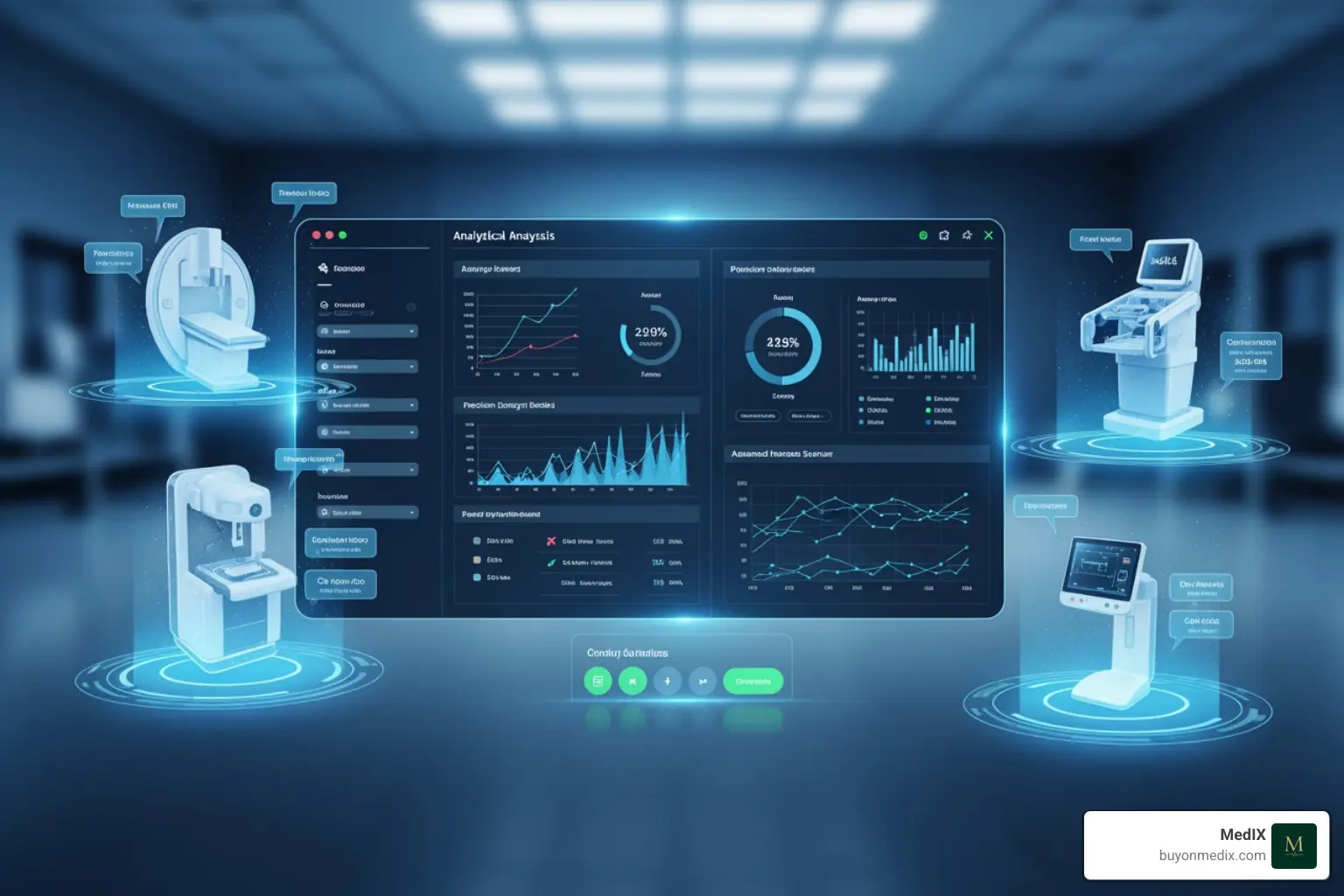
AI Smart Compare of Medical Equipment is changing how healthcare institutions purchase critical medical technology. Instead of relying on manual spreadsheets and subjective vendor pitches, these systems aggregate clinical evidence, technical specifications, cost data, and real-world performance metrics into a single, objective framework.
Key Components of AI Smart Compare:
- Data Aggregation - Pulls specifications, pricing, safety records, and user reviews from multiple sources
- Predictive Analytics - Forecasts total cost of ownership, maintenance needs, and equipment lifespan
- Clinical Matching - Aligns equipment features with specific workflow requirements and patient populations
- Performance Benchmarking - Compares devices across manufacturers and technology generations
- Compliance Verification - Ensures regulatory adherence and tracks recall histories
The medical device market is projected to grow from $810.4 billion in 2024 to $1.3 trillion by 2029, with AI integration accelerating at a 44.6% annual growth rate. However, procurement teams often struggle with inconsistent data and hidden costs, impacting patient outcomes and efficiency.
Traditional comparison is time-consuming, prone to bias, and often overlooks long-term costs or system compatibility. A 48-hour unplanned MRI outage can cost a hospital $50,000-$100,000 in lost revenue, making informed equipment selection crucial.
AI processes vast data in seconds. Machine learning identifies hidden patterns, natural language processing extracts insights from literature and feedback, and predictive models forecast future performance.
For procurement managers, AI Smart Compare provides the objective foundation for defensible decisions that balance clinical needs, financial constraints, and operational realities.
How AI-Powered Comparison Transforms Equipment Evaluation
AI integration in medical procurement is revolutionary, shifting decisions from reactive to a proactive, data-driven strategy. At its core, AI Smart Compare of Medical Equipment uses advanced technology to interpret complex information.
It starts with data aggregation, where AI gathers technical specs, pricing, safety records, user reviews, and maintenance logs. Manually cross-referencing specs for dozens of MRI machines is daunting, but AI thrives on this scale. Our machine learning models then sift this data to find patterns invisible to the human eye. For instance, an AI might link a component manufacturer to more maintenance issues.
Natural Language Processing (NLP) extracts insights from unstructured text like clinical literature, user feedback, and regulatory documents to find efficacy details, usability issues, and compliance implications. AI also uses predictive analytics to forecast the Total Cost of Ownership (TCO), maintenance needs, and equipment lifespan. This provides a true picture of the investment's lifecycle cost, not just the purchase price. The result is a comprehensive understanding that enables truly intelligent decisions.

How Does AI Smart Compare of Medical Equipment Function?
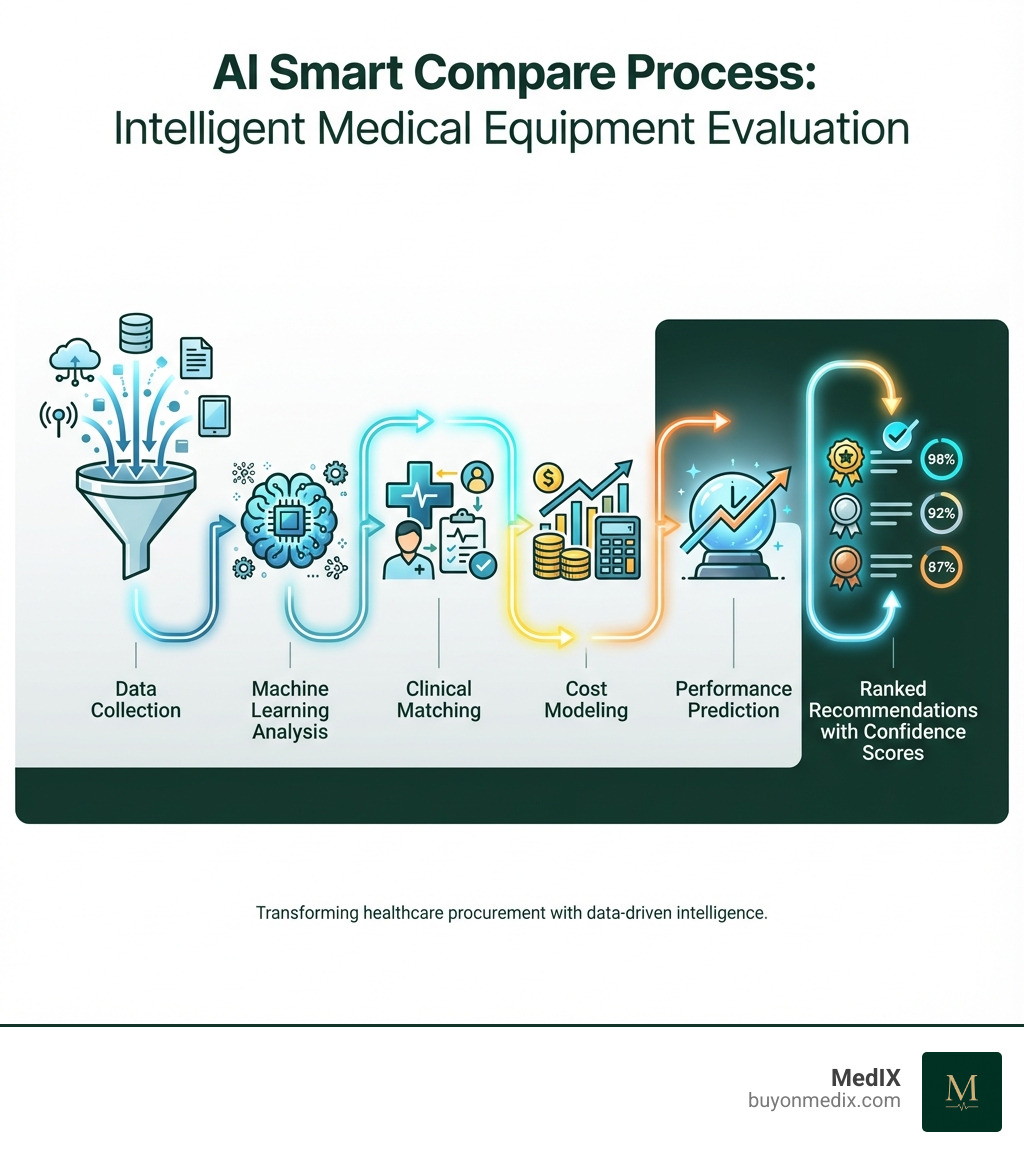
At its operational core, AI Smart Compare of Medical Equipment functions through a multi-stage process for precision and objectivity.
Data Ingestion: The system ingests data from many sources, including manufacturer datasheets, regulatory databases, clinical trials, research papers, and real-world performance data. This ensures a comprehensive dataset.
Feature Extraction: AI algorithms extract and standardize relevant features—like a CT scanner's slice count or a patient monitor's battery life—for direct comparison.
Performance Benchmarking: AI benchmarks features against industry standards and clinical guidelines. It analyzes how performance, like imaging resolution, impacts diagnostic accuracy for specific conditions.
Cost Analysis: The AI calculates the TCO, which includes installation, energy use, consumables, predicted maintenance, software licenses, and potential downtime costs. This holistic view is vital for financial planning.
Workflow Compatibility Scoring: A device must fit existing clinical workflows. Our AI scores compatibility by analyzing integration with HIS/EHR systems, user interface complexity, and departmental needs to identify the best-fit equipment.
Crucially, AI Smart Compare excels at comparing equipment across different manufacturers and generations. It uses a common framework to objectively evaluate a new device against an older model, considering both technology and cost.
What Equipment is Best Suited for AI Analysis?
While applicable to nearly any device, AI Smart Compare is most beneficial for complex, costly equipment with a critical impact on patient care and operations.
Here's a list of equipment types where AI truly shines:
High-Value Imaging Equipment: MRI, CT scanners, PET/CT systems, and advanced ultrasound machines are prime candidates. These devices have numerous technical specifications and significant TCOs. Our AI compares MRI models on factors like power capacity (3.0T vs. 1.5T), gantry size, and helium consumption. For instance, it can differentiate between a GE model's imaging capabilities and a Siemens model's "zero helium boil-off" technology.
Diagnostic Laboratory Instruments: Automated analyzers, mass spectrometers, and genetic sequencers involve complex protocols, reagent costs, and throughput rates. AI compares these intricate systems to meet specific lab needs and budgets.
Surgical Robotics: These sophisticated systems require evaluation of precision, procedural compatibility, training, and maintenance. AI assesses these aspects to help choose the best robotic assistant for surgical teams.
Patient Monitoring Systems: From ICU monitors to wearables, these systems collect vast data. Our AI compares their accuracy, connectivity, and integration. It can analyze various configurations (hand-held, wearable) and parameters (ECG, heart rate) to predict irregularities.
Life Support and Emergency Equipment: Ventilators, defibrillators, and anesthesia machines are critical for patient safety. AI compares their reliability, ease of use, specs, and maintenance profiles to ensure optimal performance when lives are on the line.
These categories involve significant cost and complexity, making them ideal for the data-driven insights AI Smart Compare provides.
The Core Benefits of AI Smart Compare of Medical Equipment
Adopting AI Smart Compare of Medical Equipment is about improving healthcare delivery. AI is an indispensable tool for Healthcare Technology Management (HTM) teams, boosting efficiency and cybersecurity. The tangible benefits for providers are significant:
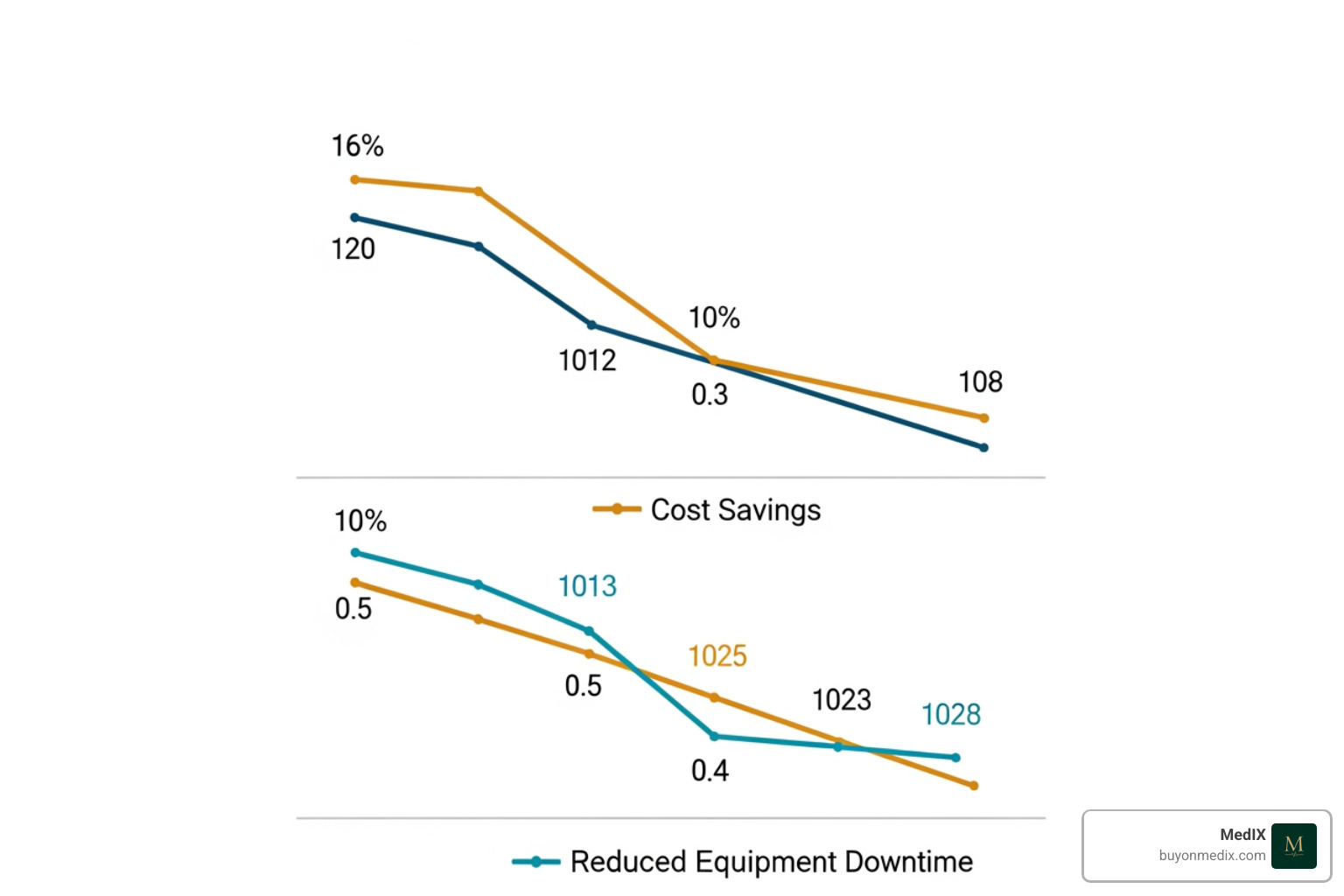
- Cost Savings: By optimizing equipment selection and predicting maintenance needs, we can dramatically reduce both upfront and long-term expenses.
- Resource Optimization: AI helps us make smarter investments, ensuring every dollar spent on equipment is maximized for patient care and operational efficiency.
- Improved Clinical Outcomes: Selecting equipment that is the best fit for specific clinical needs directly translates to better diagnostic accuracy, more effective treatments, and ultimately, improved patient safety.
- Streamlined Procurement: Tasks that took months of manual research can now be done faster and more objectively, freeing up staff time.
- Reduced Equipment Downtime: Predictive maintenance powered by AI keeps critical equipment running smoothly, avoiding costly and disruptive outages. Our research shows that customers under an AI contract have seen unplanned downtime reduced by more than 60% and maintained uptime above 99%.
Enhancing Cost-Effectiveness and ROI
AI Smart Compare of Medical Equipment emphasizes the Total Cost of Ownership (TCO) over initial price. TCO includes installation, energy use, consumables, maintenance, and downtime costs. AI analyzes these factors to ensure a sound investment.
A critical part of TCO is predictive maintenance. Powered by AI, it transforms upkeep from reactive to proactive. For example, AI platforms can ingest live data to forecast failures days in advance, allowing a CT scanner to request a tube swap before it fails. This reduces costly unplanned outages—a 48-hour MRI suite outage can equate to $50,000-$100,000 in lost revenue—saving money and ensuring continuity of care.
Furthermore, AI optimizes resource allocation by identifying equipment with the best long-term value. Organizations using AI for service management often see a 20-30% improvement in first-time fix rates and a 39% reduction in resolution time. This means less time on repairs and more equipment available for patients. For more insights into how AI is making waves in this area, we recommend exploring how AI is changing healthcare technology management.
Aligning Equipment with Specific Clinical Needs
Selecting medical equipment is a clinical decision, not just a financial one. Our AI Smart Compare systems ensure equipment aligns with specific clinical needs and workflows.
This is achieved by matching features to workflows. For instance, a pediatric cardiology unit has different ultrasound needs than a general imaging center. Our AI analyzes these nuances, cross-referencing device capabilities, software, and ergonomics.
Analyzing user feedback for usability is also key. NLP processes clinician reviews to identify pain points not on a spec sheet. This ensures equipment is intuitive and efficient for daily use.
Interoperability is paramount. AI assesses how new equipment will integrate with existing hospital information systems (HIS) or enterprise resource planning (ERP) systems. It evaluates connectivity standards and APIs to predict integration challenges, preventing data silos.
By aligning equipment with clinical needs, ensuring usability, and guaranteeing interoperability, we directly improve patient safety and care quality. Clinicians with the right tools can focus more on patients.
Implementation, Challenges, and Ensuring Trust
Realizing the full potential of AI Smart Compare of Medical Equipment requires navigating challenges. Implementation involves careful consideration of data quality, integration, ethical concerns, and regulatory adherence.
Data quality is foundational. AI is only as smart as its data. Inaccurate or biased data leads to flawed results, so we invest in robust data validation and cleansing.
Integration with existing hospital information systems (HIS) or enterprise resource planning (ERP) systems is a significant hurdle. Our AI solutions use flexible APIs and modular architectures for seamless integration with legacy systems, minimizing disruption.
Algorithmic bias is a critical ethical concern. Training data from one demographic can skew recommendations. We actively mitigate these biases through diverse datasets and rigorous testing.
Regulatory compliance is non-negotiable in healthcare. AI-enabled medical devices are subject to stringent regulations from bodies like the FDA and the EU. Our systems are built to track and adhere to these evolving standards.
Finally, staff training and adoption are key. New technology requires cultural adaptation. We work with partners to ensure teams are trained and feel empowered by the AI Smart Compare tools.
Overcoming Challenges in AI Smart Compare of Medical Equipment
Successful deployment means proactively addressing integration challenges.
Firstly, data security is paramount. We adhere to regulations like HIPAA and GDPR, using encryption, access controls, and anonymization to safeguard data. We also explore privacy-preserving techniques like federated learning.
Secondly, transparency, or Explainable AI (XAI), is crucial for building trust. Professionals need to know why an AI makes a recommendation. We provide clear rationales and confidence scores, allowing human experts to validate the AI's insights. Building this trust is a significant hurdle. For a deeper dive into this, we recommend reading about Addressing trust gaps in healthcare AI.
Managing implementation costs is also a consideration. While the long-term ROI is clear, the initial investment can be substantial. We offer scalable solutions and phased implementations to provide immediate value.
Finally, building trust requires tangible benefits and human oversight. AI augments human abilities, not replaces them. Our AI agents support, not supplant, the judgment of professionals, empowering teams with better insights to reduce skepticism.
The Role of Ethics and Regulation in AI Comparison
The ethical and regulatory landscape for AI in healthcare is rapidly evolving. Several key considerations guide our approach with AI Smart Compare of Medical Equipment.
Accountability is vital. While AI provides recommendations, humans remain responsible for final procurement decisions. Our systems are decision-support tools, ensuring human oversight is always in the loop.
Patient data privacy, governed by regulations like HIPAA and GDPR, is a cornerstone of our operations. All patient data used for AI training is rigorously anonymized and secured to comply with and anticipate privacy requirements.
The FDA's guidelines for Software as a Medical Device (SaMD) and the EU's AI Act provide frameworks for AI-powered tools. We design our systems to exceed these regulatory expectations for transparency, robustness, and human oversight, ensuring our tools are compliant.
Ensuring fairness and unbiased results is a continuous effort. We use rigorous fairness audits and bias detection, testing models on diverse datasets to correct for historical biases. Our goal is to provide equitable comparisons for all communities.
The Future of Intelligent Medical Asset Management
The future of AI in medical asset management is exciting, promising more sophisticated solutions. AI Smart Compare of Medical Equipment is just the start of a journey toward hyper-intelligent procurement and lifecycle management.
Generative AI will play a larger role, suggesting innovative solutions and designing bespoke equipment specs based on clinical needs. This leads to hyper-personalized recommendations, where AI helps define new options custom to a hospital's unique needs.
Real-time market analysis will become more dynamic. AI will monitor global supply chains, price changes, and tech breakthroughs to provide instant insights, allowing institutions to react swiftly and secure the best value.
Integration with wearable sensor data will revolutionize our understanding of equipment performance. Data from smart devices monitoring patient vitals can feed into our AI systems, providing a granular view of real-world performance and linking it to patient outcomes.
These advancements contribute to Healthcare 4.0, a vision for smart, connected healthcare where AI, IoT, and big data create an efficient, personalized, and proactive ecosystem.
Can AI Predict Long-Term Performance and Maintenance?
Absolutely. A powerful capability of AI Smart Compare of Medical Equipment is predicting long-term performance and maintenance needs, going far beyond traditional schedules.
Our AI systems perform predictive failure analysis by monitoring equipment telemetry and historical data. By identifying subtle patterns, AI can forecast component failures. For instance, AI can predict CT tube failures 72 hours in advance, allowing for proactive interventions.
This leads to AI-driven maintenance alerts, where equipment "calls for help" before breaking down. A CT scanner could automatically alert the HTM team, allowing for off-peak repairs. This has reduced unplanned downtime by over 60% and maintained uptime above 99% for customers.
By providing a lifecycle value assessment, AI helps optimize service contracts. We can negotiate contracts based on predicted maintenance needs, saving costs. Reduced downtime means equipment spends more time serving patients, maximizing its value.
What's Next for AI in the Medical Equipment Landscape?
The horizon for AI in medical equipment is full of innovation. We anticipate several trends that will reshape procurement and asset management.
Automated procurement cycles will become more sophisticated. AI will not only recommend equipment but also automate tendering, bid evaluation, and contract renewals. This frees up professionals for strategic tasks.
Sustainable and green sourcing will gain prominence. AI can analyze the environmental footprint of equipment, from manufacturing to disposal. This helps institutions make procurement decisions that align with their sustainability goals.
Improved cybersecurity will be integrated into AI platforms. As devices become more connected, AI can proactively identify vulnerabilities, monitor for threats, and recommend security protocols to protect patient data.
Rapid AI advancements, like large language models, will continue to improve the capabilities of AI Smart Compare. These technologies will enable more nuanced analysis, better understanding of clinical scenarios, and more intuitive user interfaces. For more on how AI and wearable technology are changing healthcare, we recommend exploring The emergence of AI-based wearable sensors in digital health.
Conclusion: Making Smarter, Faster Decisions for Better Healthcare
The journey through AI Smart Compare of Medical Equipment reveals a future where healthcare procurement is a strategic, intelligent function. AI transforms complex data into actionable insights for superior decision-making.
By leveraging AI, we achieve significant cost savings, optimize resources, and directly improve clinical outcomes and patient safety. Streamlining procurement and predicting maintenance needs allows institutions to operate more efficiently and focus on patient care.
A reliable comparison framework is critical. In an industry with high stakes, objective, data-driven insights are indispensable. This is the value that AI Smart Compare provides.
At MedIX, we understand these critical needs. As a global B2B marketplace, we are committed to connecting certified medical equipment suppliers with hospitals and clinics, simplifying procurement through AI-matching, rigorous compliance checks, and reliable global logistics. We ensure verified equipment and transparent transactions worldwide, providing the trusted platform for intelligent procurement.
We invite you to accept this new era of intelligent procurement. Let's work together to make smarter, faster decisions for better healthcare, ensuring that every equipment choice is an informed step towards a healthier future.

Expert voices
Insights from leaders transforming medical equipment procurement


More from our blog
Discover the latest trends in medical technology and procurement

Stay ahead of medical technology
Get the latest insights, research, and market updates delivered straight to your inbox
Ready to transform your procurement
Discover how MedIX can streamline your medical equipment sourcing process