Transforming medical equipment procurement globally


Navigating the Maze of Online Health Information

Reliable medical sources are essential for making informed health decisions, yet finding them online can feel overwhelming. Here are some of the most trusted starting points:
Top Reliable Medical Sources:
- Government Health Agencies: NIH (National Institutes of Health), CDC (Centers for Disease Control), MedlinePlus
- Academic Medical Centers: Mayo Clinic, Cleveland Clinic, Johns Hopkins Medicine
- Professional Medical Organizations: American Medical Association, specialty-specific societies
- Peer-Reviewed Journals: PubMed, JAMA, The Lancet
- Educational Institutions: University medical school websites (.edu domains)
The internet has transformed how we access health information. With a few clicks, you can research symptoms, explore treatment options, and learn about medical conditions. But this convenience comes with a serious risk: not all health information online is trustworthy.
Much of what you find can be misleading, outdated, or wrong. Self-diagnosis based on unreliable sources can lead to unnecessary anxiety, delayed treatment, or harmful decisions. The coronavirus pandemic highlighted how quickly false health claims can spread.
Used wisely, though, online health information is incredibly empowering. It helps you understand your condition, prepare questions for your doctor, and make informed decisions about your care.
The key is knowing how to evaluate what you find. This guide gives you practical steps to identify credible medical information, spot red flags, and use online resources to supplement professional medical advice, not replace it.
Whether you're a healthcare professional sourcing Certified Medical Equipment or a patient researching a diagnosis, critical evaluation skills are essential.
What Makes a Health Source Reliable?
When we talk about reliable medical sources, we are looking for accuracy, objectivity, and a commitment to public health. Your health deserves the same level of scrutiny you would give to choosing a certified mechanic for your car.
Key characteristics of reliable medical sources
Key hallmarks of trustworthiness include:
- Evidence-Based Information: Reliable sources base their claims on scientific research, clinical trials, and established medical consensus, not anecdotes or personal opinions. They often cite their sources so you can look at the original studies.
- Citing Sources: Credible sites back up claims with references to peer-reviewed journals, recognized medical textbooks, or reports from reputable health organizations.
- Author Credentials: Look for who wrote the information. Are they a doctor, registered nurse, scientist, or public health expert with relevant training? Sites like WebMD highlight that they work with a network of doctors and health experts who review and update content.
- Expert Review Process: Even if an article is written by an expert, a review by other experts adds another safeguard, similar to peer review in scientific publishing.
- Objectivity: Reliable sources present information fairly, discussing various treatment options along with potential risks and benefits, rather than pushing a single "miracle cure."
- Lack of Bias: Check for conflicts of interest. Is the site selling something or funded by a particular interest group? Strong sources prioritize facts over commercial gain or personal belief.
The role of government and established institutions
Government agencies and established medical institutions are often the best starting points for reliable medical sources. They are typically funded by public money, have a mandate to serve the public good, and employ large numbers of medical and scientific experts.
- National Institutes of Health (NIH): A cornerstone of medical research and information. The NIH website offers dependable health information on a wide range of diseases, conditions, and research findings, including topics like COVID-19 treatment guidelines. Visit Information from the National Institutes of Health.
- Centers for Disease Control and Prevention (CDC): A global leader for public health information, disease prevention, and statistics. The CDC website is highly recommended for infectious diseases, travel health, and guidelines for healthcare professionals. See the Centers for Disease Control and Prevention.
- National Library of Medicine (NLM): The world's largest medical library. Its service MedlinePlus is designed for patients and families, offering information on health topics, drugs, supplements, medical tests, and even healthy recipes, often in multiple languages and easy-to-read formats. Explore MedlinePlus health information.
As a rule, health websites sponsored by federal government agencies are accurate sources of information. You can reach all federal websites by visiting Find all federal websites here.
Medical and healthcare organizations, hospitals, and academic medical institutions like Mayo Clinic or Cleveland Clinic also provide highly reliable health information due to their research, clinical expertise, and educational missions. These institutions publish patient education materials that align with current medical understanding. Keeping up with Medical Regulatory Updates helps you understand the standards these bodies must follow.
Your 5-Step Vetting Checklist for Online Information
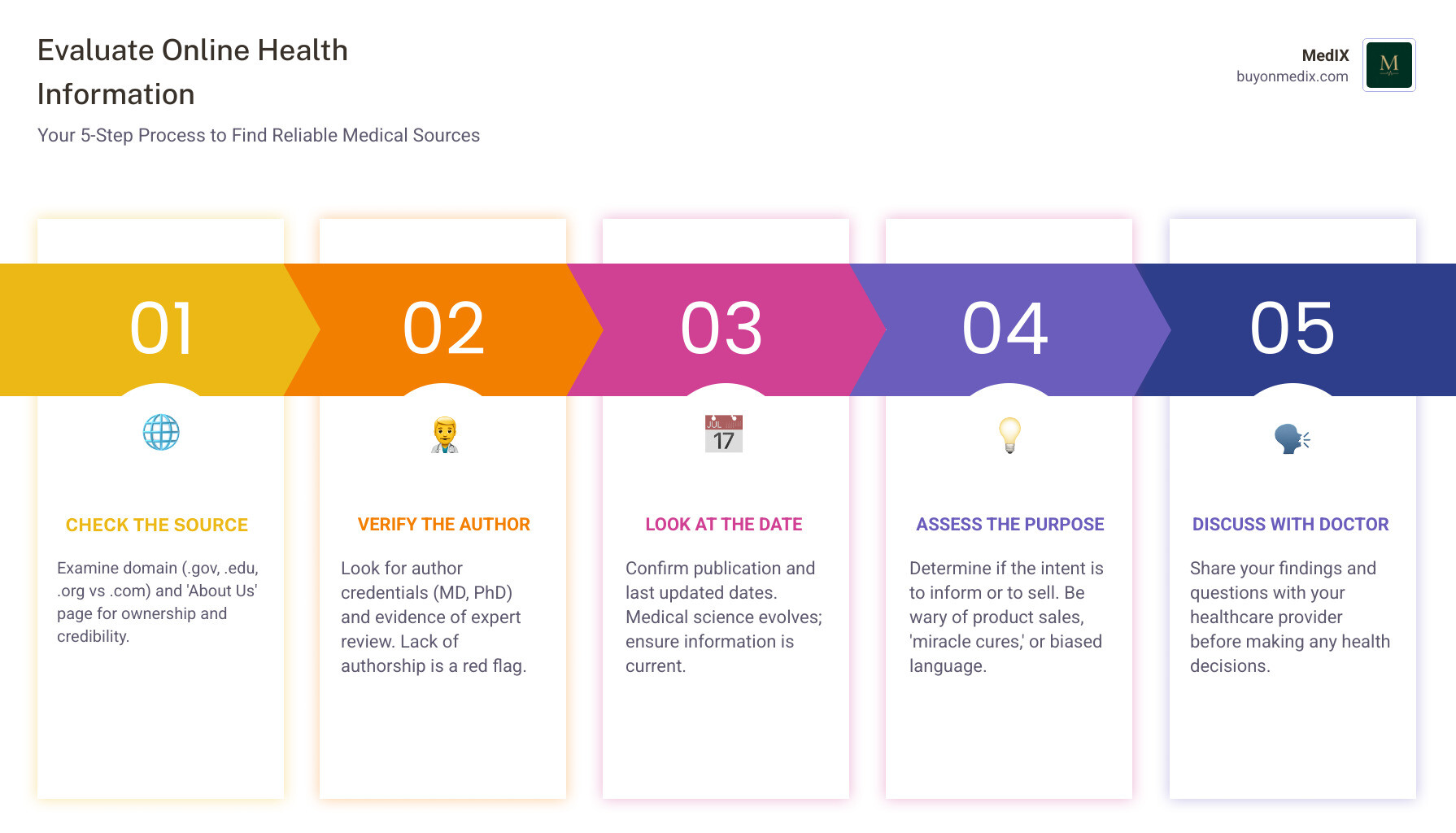
Navigating the vast ocean of online health information can feel like a treasure hunt: you are looking for gold, but there is a lot of fool's gold out there. This simple 5-step vetting checklist gives you a practical framework to assess health information every time you encounter it online.
1. Check the Source: Who is behind the information?
Start with the source. Who created the website and who is funding it? This reveals potential biases or agendas.
- Website Ownership and Sponsorship: Look for an "About Us," mission statement, or "Contact Us" section. Is it a government agency, university, non-profit, or commercial company? A business-sponsored site might present information that favors its products.
- Domain Extensions: The URL's suffix offers a quick clue:
- .gov: U.S. government agency; generally highly reliable.
- .edu: Educational institution; often provides reputable research and educational materials.
- .org: Often used by non-profits. Many are trustworthy, but some have specific agendas. Still apply the full vetting checklist.
- .com: Commercial; can be useful but often promotional. Be extra vigilant, as profit may be the primary goal.
- Contact Information: Credible sites provide clear contact details such as a physical address, phone number, or email.
- Government Websites: You can find all federal websites, which are generally accurate sources, by visiting Find all federal websites here.
2. Verify the Author: Who wrote and reviewed it?
Even on reputable sites, not all content is equally vetted.
- Author's Credentials: Look for the author's name and qualifications. Do they have an MD, PhD, RN, or other relevant certification? Are they affiliated with a recognized medical institution?
- Medical and Scientific Experts: The strongest articles are written or reviewed by experts in the subject area. Be cautious if the author is only listed as "staff writer" or "health enthusiast" without clear credentials.
- Review Board: Check whether the website mentions an editorial board or team of medical professionals who review content.
- Lack of Clear Authorship as a Red Flag: If you cannot easily find who wrote or reviewed the information, or if the credentials seem vague or irrelevant, be wary. Just as MedIX ensures that hospitals and clinics receive Certified Medical Equipment from verified suppliers, you want information from verified experts.
3. Look at the Date: Is the information current?
Medical science evolves quickly. What was best practice a decade ago might now be outdated.
- Publication Date: Always look for when the information was first written.
- Last Updated/Reviewed Date: A "last updated" or "last reviewed" date shows that content has been re-evaluated in light of new research.
- Importance in Medicine: This is crucial for fast-moving fields like infectious diseases, cancer research, or new drugs.
- Outdated Information Risks: Relying on old information can cause you to miss newer, more effective treatments or follow advice that is no longer considered safe.
4. Assess the Purpose: Is it to inform or to sell?
Consider the site's underlying motivation.
- Informational vs. Commercial Intent: Is the primary goal to educate or to sell? Many sites mix education and advertising. Be aware of how ads might influence content.
- Product Sales: Be skeptical if a site heavily pushes a particular supplement, device, or "cure."
- "Miracle Cures": Quick fixes or "miracle cures" for serious conditions are a major red flag. Real breakthroughs are published in scientific channels and validated by research.
- Biased Language: Watch for overly emotional, sensational, or fear-based language. Objective information is clear and neutral.
- Testimonials vs. Scientific Evidence: Personal stories are not scientific evidence. Reliable medical sources base advice on data from studies involving many people, not just individual experiences.
5. Protect Your Privacy: Is your data safe?
Guard your personal and health information.
- Privacy Policy: A reputable site has a clear privacy policy explaining what information is collected, how it is used, and whether it is shared with third parties.
- Use of Cookies: The policy should explain cookie use and ideally offer options to manage them.
- Secure Connections (HTTPS): Before entering personal information, check for "https://" and a padlock icon, indicating an encrypted connection.
- Data Collection Practices: Be cautious about sites or apps asking for excessive personal data that is not clearly necessary. When using public Wi-Fi, be especially aware of security risks; learn more about Learn about public Wi-Fi safety.
Red Flags and Pitfalls: Spotting Misinformation Across Platforms
The internet offers countless avenues for information, but it also provides fertile ground for misinformation. While the 5-step checklist helps you vet websites, it is especially important to be cautious with less formal platforms.
Health information on social media, blogs, and forums
Social media, personal blogs, and online forums are full of personal stories and opinions.
- Anecdotal Evidence: A compelling story is not the same as scientific proof. What helped one person might not be safe or effective for others.
- Personal Stories vs. Data: Clinical trials involving many participants provide far more reliable evidence than single experiences.
- Unverified Claims: On social media, claims can spread rapidly without fact-checking. A post about a "new cure" can go viral even if it is unfounded.
- Echo Chambers: Algorithms often show content that matches your existing beliefs, reinforcing misinformation and limiting exposure to evidence-based perspectives.
- Finding the Original Source: If you see a health claim that interests you, try to trace it back to the original source. If you cannot find it, or if it fails the 5-step checklist, treat it with skepticism.
Connecting with others in support groups can be valuable for emotional support and shared experiences, but these communities are not substitutes for professional medical advice. You can Connect with support groups for community while still verifying medical advice with a doctor.
How to spot health fraud and miracle cures
Health fraud and "miracle cures" often promise easy solutions to complex problems. Warning signs include:
- Promises of a Quick Fix: Be suspicious of claims offering rapid, dramatic results for serious conditions without effort or side effects.
- Secret Formulas or Cures: Claims that something is a "secret cure" that doctors supposedly do not want you to know about are almost always scams.
- Cures for All Diseases: No single product can cure a wide range of unrelated diseases.
- "All-Natural" Claims: "All-natural" does not automatically mean safe or effective.
- Conspiracy Theories: Be wary of narratives claiming that the medical establishment or government is suppressing a "real cure" for profit.
- Testimonials Instead of Scientific Evidence: Heavy reliance on testimonials rather than well-designed studies is a red flag.
- No Risk or Side Effects: Every effective treatment has some potential risks or side effects.
MedlinePlus provides guidance on recognizing these scams. Always Beware of health fraud scams and question sensational claims.
Evaluating medical apps and tools
Medical apps and online tools, from symptom checkers to fitness trackers, are increasingly common. Their reliability and data practices vary widely.
- App Developers: Check who developed the app. Is it a reputable medical institution, government agency, or established healthcare company? Anyone can release a health app.
- Data Privacy Concerns: Understand the app's privacy policy. What data does it collect? How is it used? Is it shared with third parties? This is especially important with the rise of AI in Medicine, where large datasets are often involved.
- Accuracy of Tools: Symptom checkers can help you frame questions, but they are not diagnostic tools and should not replace a consultation with a healthcare professional.
- Regulation: Many health apps do not face the same regulatory scrutiny as medical devices (such as Durable Medical Equipment or Medical Equipment that MedIX helps provide). Look for apps reviewed or recommended by medical professionals or reputable health organizations.
Frequently Asked Questions about reliable medical sources
This section addresses common questions that arise when navigating reliable medical sources online.
How should I discuss online health information with my doctor?
Finding information online is often a first step, not the final one. Your healthcare provider is your most important partner.
- Be Open and Honest: Tell your doctor what you have read online. Many clinicians expect patients to research on their own and can help you interpret what you find.
- Bring a List of Questions: Instead of saying, "I read on the internet that I have X," try, "I saw information about condition X. Could it be relevant to me?" Use your research to frame focused questions.
- Share Your Sources: If a specific article or website concerns or interests you, share it. Your doctor can quickly assess its credibility and relevance.
- View It as a Partnership: Use online information to understand options and risks, and to participate actively in decisions.
- Do Not Make Changes Without Consulting Them: Avoid changing medication, diet, or treatment plans based solely on online advice. Your doctor knows your medical history and can personalize guidance.
What's the difference between a research study and a news article?
Understanding this distinction helps you interpret health claims more accurately.
- Research Studies are Primary Sources: A research study (such as a clinical trial) is original scientific work, usually published in peer-reviewed journals. If you want to explore new treatments, you can Clinical Trials Clinical Trials directly. Studies include data, methodology, and detailed conclusions.
- News Articles are Secondary Sources: News stories, blogs, or popular science pieces summarize or interpret one or more studies for a general audience.
- Potential for Misinterpretation in News: News pieces may oversimplify, sensationalize, or omit important limitations. If a news article makes a bold or "breakthrough" claim, try to locate the underlying study.
Are .org websites always reliable?
The short answer: not always.
- Many are Trustworthy Advocacy or Research Groups: Examples include disease-specific organizations (such as the American Cancer Society), professional associations, or research foundations. Their mission is often public education and advancing knowledge.
- Some Have a Specific Agenda or Bias: The .org domain is open to many types of non-profits, including those with strong ideological positions or a focus on unproven therapies.
- Always Apply the 5-Step Vetting Checklist: Treat .org sites the same way you treat any other domain: check ownership, authorship, dates, purpose, and privacy practices. If an .org is selling products or promoting unconventional treatments without strong evidence, be cautious.
Conclusion: Becoming an Empowered Health Advocate
Navigating the vast sea of health information online can be challenging, but with critical evaluation skills, you can become an empowered advocate for your own health and for those you care for. Reliable medical sources share common features: they are evidence-based, transparent about who creates and reviews content, current, objective, and respectful of your privacy.
Remember these key steps: check the source and its ownership, verify author credentials, confirm that information is up to date, assess whether the purpose is to inform or to sell, and protect your personal data. Be cautious with social media, blogs, and any claims of "miracle cures."
The goal is not to replace professional medical advice with internet searches, but to use online information to improve your conversations with healthcare providers. Treat your doctor as a partner and bring well-researched questions to your visits.
Your health is a priority, and thinking critically about the information you consume is a vital part of taking charge of your well-being. Just as MedIX is committed to ensuring healthcare providers have access to verified and Durable Medical Equipment from trusted suppliers, you can commit to seeking verified, trustworthy information for your health decisions.
Ready to connect with reliable medical suppliers or find trusted buyers? Connect with certified medical suppliers and buyers on MedIX today.

Expert voices
Insights from leaders transforming medical equipment procurement


More from our blog
Discover the latest trends in medical technology and procurement

Stay ahead of medical technology
Get the latest insights, research, and market updates delivered straight to your inbox
Ready to transform your procurement
Discover how MedIX can streamline your medical equipment sourcing process